THE MYTHOLOGY FIELD GUIDE 11
Divine Beasts
Zhuque
朱雀Zhūquè
Zhuque, the Vermilion Bird, gives the southern sky a feathered guardian. Associated with summer and fire, this celestial bird belongs to a system of directional symbols rather than one adventure story. It may resemble a magnificent phoenix in art, but its particular job is keeping the cosmic compass pointed south.
01 / THE PORTRAIT
Appearance
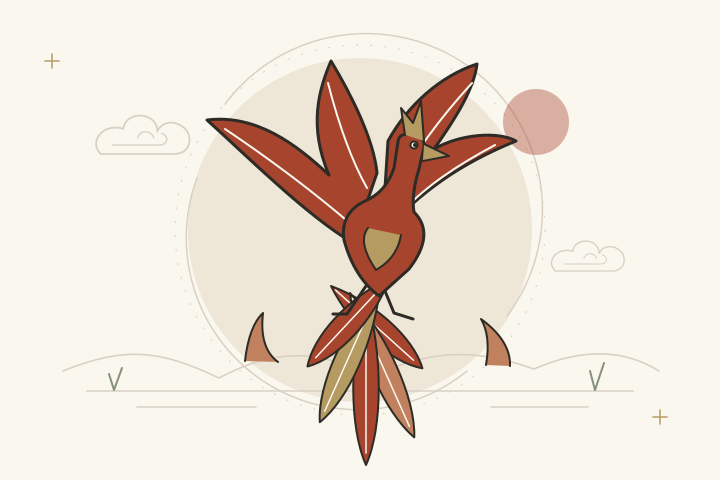
Imagine a red bird with spreading wings and a sweeping tail: that is a useful modern introduction to Zhuque. Traditional images vary, and the early texts emphasize its position and symbolic color rather than supplying a detailed anatomical checklist. Its feathers can become flowing ribbons in decorative art, while contemporary illustrators often surround the bird with flames. Those flames visualize its association with fire; they do not establish an ancient story about a bird literally burning. Zhuque can look similar to the fenghuang, but visual resemblance does not make their names interchangeable. Our illustration presents the southern guardian as a stylized celestial bird.
02 / THE STORY
Origins & Legends
Zhuque belongs to the history of Chinese astronomy and ritual symbolism. Early works often call the southern emblem Zhu Niao, the Vermilion Bird. The Book of Rites places this bird at the front of a procession or military formation, with Xuanwu behind, Qinglong to the left, and Baihu to the right. Facing south makes those positions line up with the four directions.
The Huainanzi, a philosophical collection from the Han period, links the south with fire, summer, and the Vermilion Bird. The Records of the Grand Historian also names a Vermilion Bird in its account of the southern celestial region. These passages give us a framework of correspondences: sky, season, direction, and animal belong together.
Later religious and artistic traditions developed the directional guardians further. Modern fantasy often turns Zhuque into an individual character with dramatic fire powers. That is a creative expansion of its symbolism, rather than a single biography preserved in the earliest sources. For a first encounter, think of Zhuque as a picture that organizes the universe: the southern part of an enormous celestial map.
03 / THE MEANING
Cultural Significance
Zhuque makes an abstract system easy to remember. South becomes a bird, summer gains a color, and fire has a recognizable emblem. Read alongside Qinglong, Baihu, and Xuanwu, it shows how Chinese traditions connected observations of the sky with earthly space and seasonal change. The four guardians also offer artists a balanced set of contrasting forms: dragon, tiger, bird, and tortoise with snake. For today's reader, Zhuque is a helpful reminder that a mythical creature can be meaningful without defeating a villain. Sometimes its greatest cultural achievement is giving people a beautiful way to arrange a complicated world.
04 / FOLLOW THE PAPER TRAIL
Ancient Sources
Original Chinese texts and source notes. A later legend is not evidence of an ancient account; surviving editions may preserve material from different periods.
Ancient text
Book of Rites — Qu Li I
《禮記·曲禮上》
Names the Vermilion Bird at the front of a formation alongside the other three directional emblems.
Ancient text
Huainanzi — Patterns of Heaven
《淮南子·天文訓》
Associates the south, fire, summer, and the Vermilion Bird in its system of cosmic correspondences.
Ancient text
Records of the Grand Historian — Treatise on the Celestial Officials
《史記·天官書》
The southern celestial region is identified with the Vermilion Bird; this is astronomical symbolism, not a creature biography.
05 / SMALL SURPRISES
Fun Facts
Zhu means vermilion, a vivid red; que means a bird or sparrow in different contexts.
Early sources frequently use Zhu Niao, meaning Vermilion Bird, for the southern emblem.
The Book of Rites puts the bird at the front, matching south when the formation faces that direction.
Zhuque and the fenghuang can resemble one another in illustrations, but their traditional roles differ.
Retold in English by LET.AC with AI assistance. Mythology has many versions; this entry follows the source notes above.