THE MYTHOLOGY FIELD GUIDE 09
Dragons
Qinglong
青龙Qīnglóng
Qinglong is the dragon with a particular place in the cosmic map: the east. Often called the Azure Dragon, it belongs to the four directional guardians and carries spring and wood associations. Its blue-green name describes a traditional color range, while its long form helps turn a region of the heavens into a memorable creature.

01 / THE PORTRAIT
Appearance
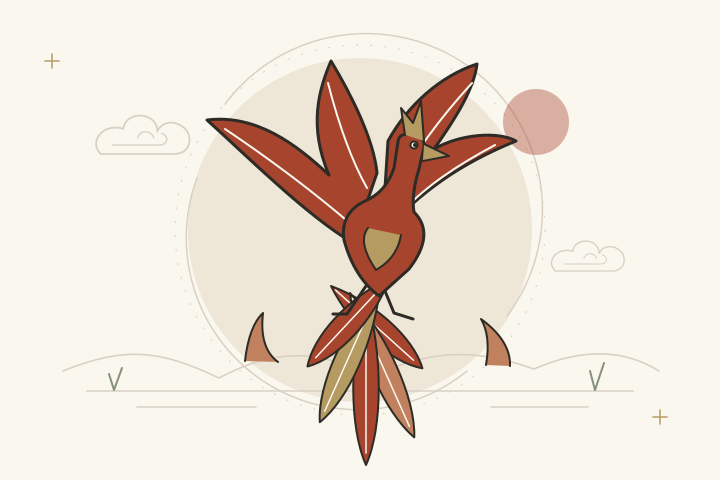
Qinglong usually appears as a long, horned dragon with a curling body and clawed limbs. Modern illustrations favor blue, green, or turquoise, reflecting the broad color sense of qing. Historical representations may be cast in bronze or carved in stone, so literal blue-green paint is not necessary for identification. Placement beside the tiger, bird, and tortoise-snake can be more informative than color alone. Our illustration uses a flowing dragon silhouette and cool tones as a contemporary interpretation. Its clouds and sweeping movement evoke the celestial role, but they do not reproduce a specific constellation chart or a single documented ancient painting.
02 / THE STORY
Origins & Legends
Qinglong belongs to a tradition that organizes the heavens through animal images. The Huainanzi calls the eastern creature Canglong, another color term often rendered as azure, and connects it with spring and wood. These correspondences belong to an interlocking cosmic model rather than an individual dragon’s life story.
The Book of Rites supplies another context. In its Quli passage, the dragon occupies the left in an ordered arrangement that also places the white tiger at the right, the red bird in front, and Xuanwu behind. Commentarial traditions explain the setting through ceremonial or military organization. Looking at the whole arrangement matters more than treating the dragon as an isolated decorative animal.
Surviving mirrors bring the pattern into view. A Han mirror at the Smithsonian places all four directional creatures around a central area as part of a symbolic diagram of the universe. Such an object suggests how a familiar personal possession could also express a cosmic order. Later religious and fictional traditions may assign Qinglong additional titles or powers, but those developments should be identified separately from the early directional associations.
03 / THE MEANING
Cultural Significance
Qinglong offers a way to connect a powerful creature with orientation and seasonal change. Its relationship with Baihu, Zhuque, and Xuanwu makes the group readable as a system: each figure occupies a place and helps define the others. That system appears in decorative art as well as written cosmology. Today the Azure Dragon is popular in fantasy because its name and colors make a striking character, but its older role is especially interesting when viewed alongside its companions. Recognizing Qinglong as a specific eastern guardian also avoids turning every blue or green Chinese dragon into the same named being.
04 / FOLLOW THE PAPER TRAIL
Ancient Sources
Original Chinese texts and source notes. A later legend is not evidence of an ancient account; surviving editions may preserve material from different periods.
Ancient text
Huainanzi — Tianwen, Celestial Patterns
淮南子·天文訓
Names Canglong in the eastern correspondence system, together with wood and spring.
Ancient text
Book of Rites — Quli, Part 1
禮記·曲禮上
Places the blue-green dragon on the left within an ordered arrangement of the four animal emblems.
Later tradition
Mirror with the Animals of the Four Directions — Smithsonian Institution
A first- to second-century Han bronze mirror, Freer Gallery object F1937.30, illustrating the four directional creatures as a cosmic diagram.
05 / SMALL SURPRISES
Fun Facts
Qing can cover blue-green shades, so Azure Dragon and Green Dragon are both encountered in English.
The Huainanzi uses the related name Canglong for the eastern creature.
In the four-guardian arrangement, Qinglong’s traditional direction is east.
Historical bronze representations can be identified by context even when they have no blue or green coloring.
Retold in English by LET.AC with AI assistance. Mythology has many versions; this entry follows the source notes above.