THE MYTHOLOGY FIELD GUIDE 01
Dragons
Dragon
龙Lóng
Meet the long, a creature that can glide through clouds without needing a pair of wings. Chinese dragons connect water, weather, power, and good fortune, but their personalities vary between texts. Some are celestial symbols; others become demanding rulers of rivers and seas in later storytelling. There is a whole dragon family to explore.
01 / THE PORTRAIT
Appearance
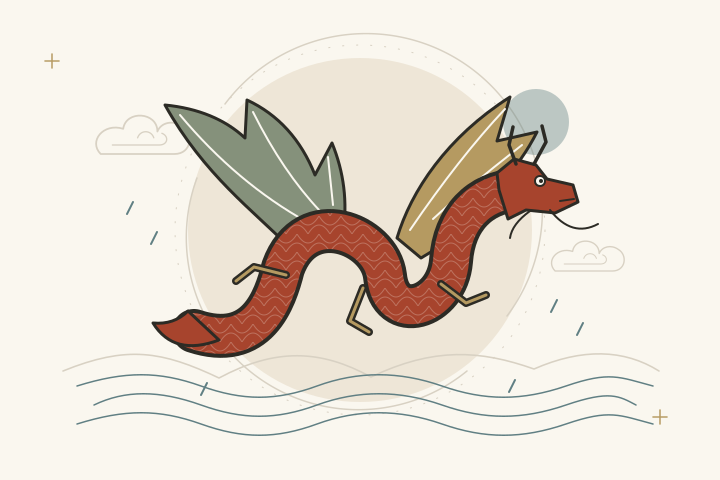
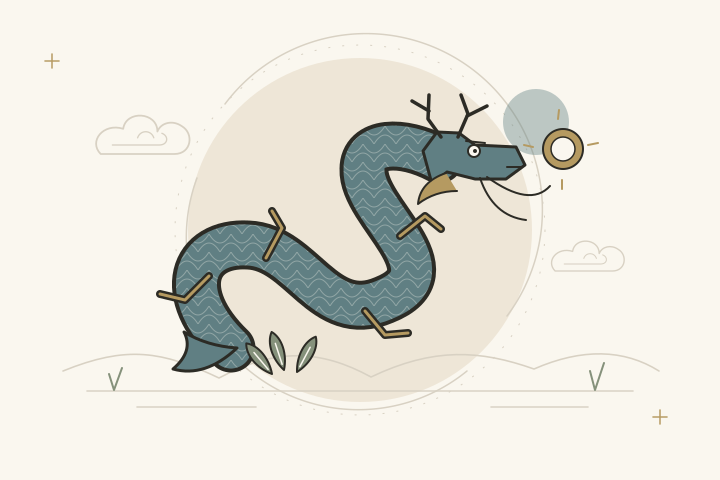
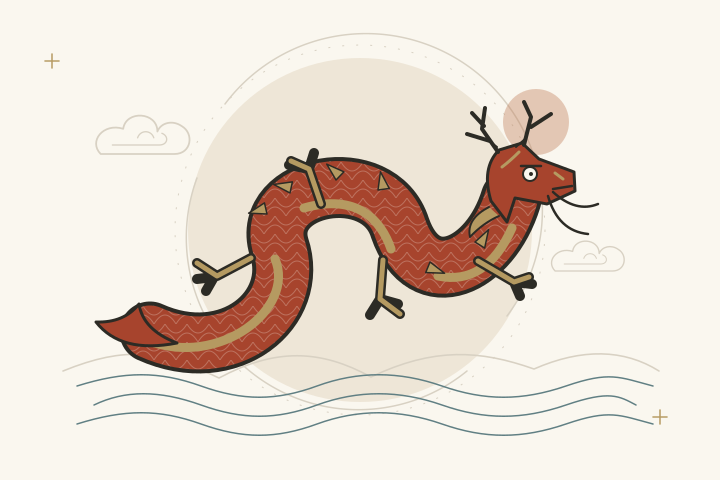
The familiar artistic dragon has a winding, scaled body, clawed feet, horns, whiskers, and an expressive face. It can curl around a vase or stretch across a painted sky, which makes its flexible silhouette especially useful to artists. Our illustration follows that broad visual tradition rather than reproducing one ancient object. Early dragon forms differ considerably, and a dragon does not always have the same number of claws, limbs, or horns. The winged Yinglong is an especially useful reminder that the popular wingless shape is only one possibility. A long body and cloud setting are visual clues, not a scientific identification guide.
02 / THE STORY
Origins & Legends
In the Zhouyi, usually called the Book of Changes, the first hexagram uses dragons to describe changing situations: a dragon remains hidden, appears in a field, and eventually flies in the sky. The sequence also warns that rising too high can bring regret. Here the creature helps readers think about timing and responsibility; the passage is not a report of an animal sighting.
Dragon traditions developed across many periods and genres. Ancient cosmological writing connects dragon imagery with the eastern direction, while later art repeatedly places dragons among clouds and water. The dragon kings familiar from novels belong to a different narrative setting, where supernatural courts can resemble human governments. Those stories should not be read back into every early mention of a dragon.
Likewise, an imperial dragon on a Qing court object and a dragon in a village celebration have different contexts. The shared image can suggest authority, hoped-for rain, protection, or festive energy. Asking where and when a dragon appears is more revealing than assigning every dragon one personality. Qinglong and Yinglong show how a general creature name can also develop into a much more specific mythical identity.
03 / THE MEANING
Cultural Significance
Dragons remain one of the most recognizable images in Chinese culture. They appear in architecture, ceramics, textiles, festivals, and the twelve-animal zodiac. A Qing porcelain vase at The Metropolitan Museum of Art shows how clouds and a dragon can carry several associations at once, including water and imperial authority. Court regulations and privileges changed, so counting claws alone does not explain every historical object. For visitors encountering the motif today, context matters: a ceremonial robe communicates something different from a cheerful festival dragon. Both belong to a long, adaptable visual language that artists and storytellers continue to reinterpret.
04 / FOLLOW THE PAPER TRAIL
Ancient Sources
Original Chinese texts and source notes. A later legend is not evidence of an ancient account; surviving editions may preserve material from different periods.
Ancient text
Book of Changes — Qian, Hexagram 1
周易·乾
The hexagram and its commentaries use hidden, emerging, and flying dragons as images of changing circumstances.
Later tradition
Vase with Dragon amid Clouds — The Metropolitan Museum of Art
An early eighteenth-century Qing vase, object 32.100.434, with curatorial notes on water, protection, and court associations.
05 / SMALL SURPRISES
Fun Facts
The dragon is the only mythological creature among the twelve animals of the Chinese zodiac.
The Book of Changes includes both a flying dragon and a warning about a dragon that has risen too high.
Many Chinese dragons fly without wings, but Yinglong belongs to a winged dragon tradition.
Qinglong is the eastern celestial guardian, rather than a name for every Chinese dragon.
Retold in English by LET.AC with AI assistance. Mythology has many versions; this entry follows the source notes above.