THE MYTHOLOGY FIELD GUIDE 18
Dragons
Zhu Long
烛龙Zhúlóng
Zhu Long, the Torch Dragon, makes ordinary dragon powers seem modest: its gaze is associated with daylight and darkness. The Classic of Mountains and Seas describes a red, human-faced serpent in a remote northern landscape. A closely related figure, Zhuyin, connects breathing with seasons and wind. These are cosmic images rather than a conventional monster chase.
01 / THE PORTRAIT
Appearance
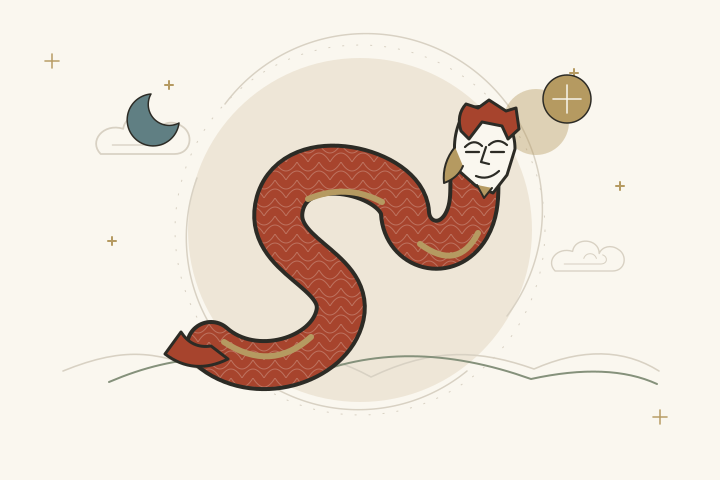
In the Great Wilderness of the North, Zhu Long has a human face and a red serpent's body. Its eyes and gaze matter because opening or closing them changes the world's light. The Northern Regions Beyond the Seas describes the related Zhuyin with the same broad combination of human face, red color, and serpentine body, adding an immense length of a thousand li. That scale belongs to mythic geography, not a measurable specimen. Modern artists may add horns, a mane, or luminous patterns to emphasize dragon identity. Our illustration is a stylized interpretation; those ornamental details should be distinguished from the sparse ancient description.
02 / THE STORY
Origins & Legends
The Great Wilderness of the North places Zhu Long at Mount Zhangwei, beyond the northwestern sea and north of the Red Water. Its passage describes a red deity with a human face and serpent body. Closing its eyes brings darkness; looking brings light. It does not eat or sleep like an ordinary living creature, and its presence belongs to a landscape already filled with extraordinary beings.
A closely related account in the Northern Regions Beyond the Seas names the god of Mount Zhong Zhuyin. Here, looking creates day and closing the eyes creates night, while blowing and breathing are associated with winter, summer, and wind. The shared features explain why readers commonly discuss the passages together, but the names, locations, and exact descriptions are not identical.
These accounts imagine changes in the natural world through the body of a deity. A blink can have the scale of a night; breath can have the force of a season. Modern attempts to connect Zhu Long with particular natural phenomena remain interpretations unless supported separately. The ancient passages themselves offer a mythic picture, not an identified astronomical mechanism or a single complete creation story.
03 / THE MEANING
Cultural Significance
Zhu Long makes vast patterns intimate. Daylight becomes a gaze, darkness a closed eye, and the seasons something like breathing. That is part of mythology's imaginative strength: it gives familiar bodily actions the scale of the world. The northern setting and colossal serpent form also create an atmosphere of distance and mystery. For readers exploring Chinese dragons, Zhu Long demonstrates the variety hidden behind that broad label. Its central concern is cosmic rhythm, rather than imperial ceremony or an individual rainstorm. Keeping Zhu Long and the closely related Zhuyin passages visible allows the creature's complexity to survive modern retelling.
04 / FOLLOW THE PAPER TRAIL
Ancient Sources
Original Chinese texts and source notes. A later legend is not evidence of an ancient account; surviving editions may preserve material from different periods.
Ancient text
Classic of Mountains and Seas — Great Wilderness of the North
《山海經·大荒北經》章尾山條
Names Zhu Long and describes the red, human-faced serpent whose gaze and closed eyes correspond to light and darkness.
Ancient text
Classic of Mountains and Seas — Northern Regions Beyond the Seas
《山海經·海外北經》鍾山條
The closely related deity Zhuyin controls day and night, with breath associated with seasons and wind; its name and setting differ from the Zhu Long passage.
05 / SMALL SURPRISES
Fun Facts
Zhu, 燭, means torch or candle; Torch Dragon is a common English rendering of the name.
The Great Wilderness of the North describes Zhu Long as red, human-faced, and serpent-bodied.
The closely related Zhuyin account says the body extends for a thousand li, a distance of mythic scale.
Zhu Long and Zhuyin share important features, but their passages use different names and mountains.
Retold in English by LET.AC with AI assistance. Mythology has many versions; this entry follows the source notes above.