THE MYTHOLOGY FIELD GUIDE 17
Dragons
Yinglong
应龙Yìnglóng
Yinglong is a dragon of battles and rain, helping the Yellow Emperor in legends recorded by the Classic of Mountains and Seas. Later interpretation gives it wings, making it visually distinctive among Chinese dragons. Its stories connect supernatural warfare with water, drought, and the hope that a dragon-shaped image might bring the rain back.
01 / THE PORTRAIT
Appearance
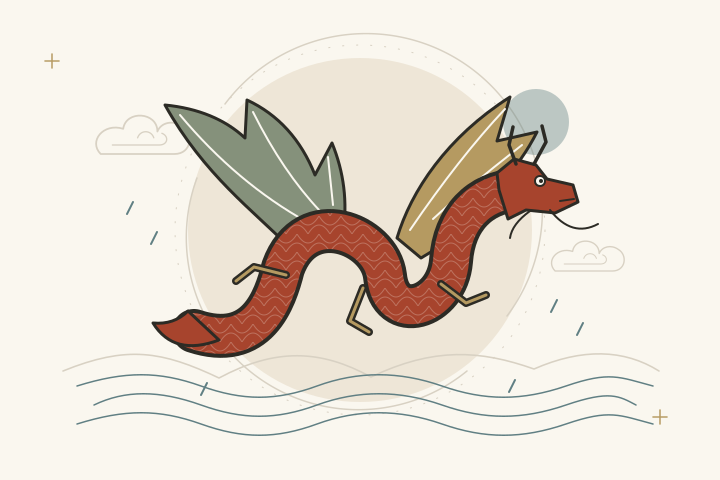
Yinglong is commonly represented as a long Chinese dragon with a pair of wings. The third-century Guangya identifies it as a winged dragon; the principal battle passages of the earlier Classic of Mountains and Seas do not provide that anatomical description. A coiling body and broad wings communicate both its dragon identity and its ability to move through the heavens. Horns, scales, claws, and wing textures vary between artists. Our illustration uses that familiar winged interpretation. Reading its oldest narratives, however, requires imagining less specified anatomy: the text gives Yinglong actions and a relationship with water, while leaving many of its visible details open.
02 / THE STORY
Origins & Legends
The Classic of Mountains and Seas preserves several connected but not identical Yinglong accounts. In the Great Wilderness of the North, the Yellow Emperor sends Yinglong against Chiyou. Yinglong gathers water, while Chiyou calls upon powers of wind and rain. The drought figure Ba then helps stop the rain, and the battle turns. This is a mythic struggle between supernatural forces, not a historical military report.
Another passage connects Yinglong with killing Chiyou and Kuafu before settling in the south, explaining that region's rain. The Great Wilderness of the East says that after killing those figures, Yinglong cannot return above. Droughts follow, and making an image in Yinglong's shape brings heavy rain. The geography and emphasis differ, so the passages should be read as related traditions rather than forced into a perfectly consistent itinerary.
The Guangya, a third-century dictionary, identifies Yinglong as a winged dragon. That recognizable image adds a distinctive body to stories already concerned with atmospheric power. Together, the accounts make Yinglong a useful introduction to a recurrent theme: dragons connect the human need for water with an imagined world of celestial actors.
03 / THE MEANING
Cultural Significance
Yinglong reveals the agricultural stakes behind spectacular mythology. A battle involving wind, rain, and drought is impressive, but those same forces determine whether fields receive enough water. The passage about making a dragon-shaped image during drought shows how a story could imagine ritual action as a response to uncertainty. Readers can appreciate that meaning without treating the ritual as a scientific method for changing weather. Yinglong also broadens the familiar picture of Chinese dragons: the winged tradition has its own history and should not be flattened into one universal dragon design. Its importance lies in both the drama overhead and the vulnerable lives below.
04 / FOLLOW THE PAPER TRAIL
Ancient Sources
Original Chinese texts and source notes. A later legend is not evidence of an ancient account; surviving editions may preserve material from different periods.
Ancient text
Classic of Mountains and Seas — Great Wilderness of the North
《山海經·大荒北經》
Records Yinglong helping the Yellow Emperor against Chiyou, gathering water, and a separate account connecting its southern residence with rain.
Ancient text
Classic of Mountains and Seas — Great Wilderness of the East
《山海經·大荒東經》
Connects Yinglong's inability to return above with drought and the making of its likeness with the arrival of rain.
Later tradition
Guangya — Explanation of Fish
《廣雅·釋魚》
This third-century dictionary identifies Yinglong as a winged dragon, a later anatomical classification than the mountain classic's battle accounts.
05 / SMALL SURPRISES
Fun Facts
The Great Wilderness of the North makes Yinglong a helper of the Yellow Emperor in the battle against Chiyou.
The Great Wilderness of the East associates a Yinglong-shaped image with prayers or action for rain during drought.
The principal battle passages do not themselves provide a detailed description of wings.
Different passages connect Yinglong's southern residence with rainfall in different ways.
Retold in English by LET.AC with AI assistance. Mythology has many versions; this entry follows the source notes above.