THE MYTHOLOGY FIELD GUIDE 10
Divine Beasts
Baihu
白虎Báihǔ
Baihu, the White Tiger, gives the western direction a fierce and memorable guardian. In Chinese cosmological traditions it is associated with autumn and metal, and it appears alongside a dragon, a red bird, and a tortoise-snake. This celestial figure carries symbolic meaning beyond the appearance of a pale tiger in the natural world.
01 / THE PORTRAIT
Appearance
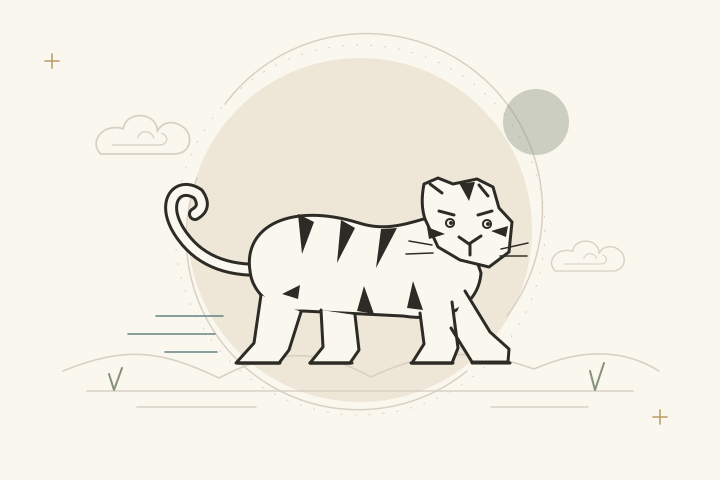
The White Tiger keeps a recognizably feline shape: a muscular body, powerful paws, a long tail, and an alert face. Stripes can remain visible even when artists emphasize its white coat. Historical images may elongate the body or curl the tail to fit a mirror, tile, or narrow decorative band. Those stylizations make the beast part of a composition rather than an anatomical study. Our illustration uses pale coloring, bold stripes, and a poised stance as a modern interpretation. A bronze depiction can represent Baihu without literal white pigment; its place within the four-guardian group and the object’s context are important clues.
02 / THE STORY
Origins & Legends
The Huainanzi’s Tianwen chapter assigns the white tiger to the western direction and links that region with metal and autumn. The creature is one element in a wide pattern of cosmic correspondences, not the protagonist of one definitive ancient adventure. Baihu’s symbolic role becomes clearer when read with the other directions.
The Book of Rites places the white tiger at the right of an ordered arrangement, opposite the blue-green dragon. This passage connects the animal emblem with organization and orientation. It should not be treated as a story about two beasts constantly fighting each other.
Material evidence adds a different perspective. An Eastern Han bronze mirror at the Cleveland Museum of Art shows the White Tiger with divine figures and a chariot. The museum notes that not all aspects of the composition are understood. The tiger’s presence is recognizable, yet recognition does not solve every question about the object. Later images and modern fantasy can add combat powers, dramatic rivalries, or a personal biography. Those additions may be exciting storytelling, but they should be distinguished from the earlier directional and seasonal framework.
03 / THE MEANING
Cultural Significance
Baihu brings a forceful animal image into an ordered cosmic world. Its association with the west means it often appears in relation to other guardians, where position helps communicate meaning. The tiger’s physical strength also makes it an appealing figure for contemporary stories about courage and protection. Those modern character traits should be read alongside, rather than substituted for, its older cosmological role. Museum objects offer a useful middle ground: they show the guardian embedded in a particular design with a particular date. Looking at that setting helps readers appreciate both the confidence of the image and the uncertainties of its interpretation.
04 / FOLLOW THE PAPER TRAIL
Ancient Sources
Original Chinese texts and source notes. A later legend is not evidence of an ancient account; surviving editions may preserve material from different periods.
Ancient text
Huainanzi — Tianwen, Celestial Patterns
淮南子·天文訓
Names the white tiger in the western correspondence system, together with metal and autumn.
Ancient text
Book of Rites — Quli, Part 1
禮記·曲禮上
Places the white tiger on the right opposite the blue-green dragon in the four-emblem arrangement.
Later tradition
Mirror with Deities, Chariot, and the White Tiger — Cleveland Museum of Art
An Eastern Han mirror dated 100–200 CE, object 1995.332, whose curatorial note identifies the western guardian while acknowledging uncertain details.
05 / SMALL SURPRISES
Fun Facts
Baihu literally means White Tiger.
Its traditional correspondences include west, autumn, and metal.
A historical bronze White Tiger need not be painted white to function as the emblem.
The Cleveland Museum’s Eastern Han mirror demonstrates that a recognizable guardian can appear in a composition whose full meaning remains uncertain.
Retold in English by LET.AC with AI assistance. Mythology has many versions; this entry follows the source notes above.