THE MYTHOLOGY FIELD GUIDE 02
Divine Beasts
Phoenix
凤凰Fènghuáng
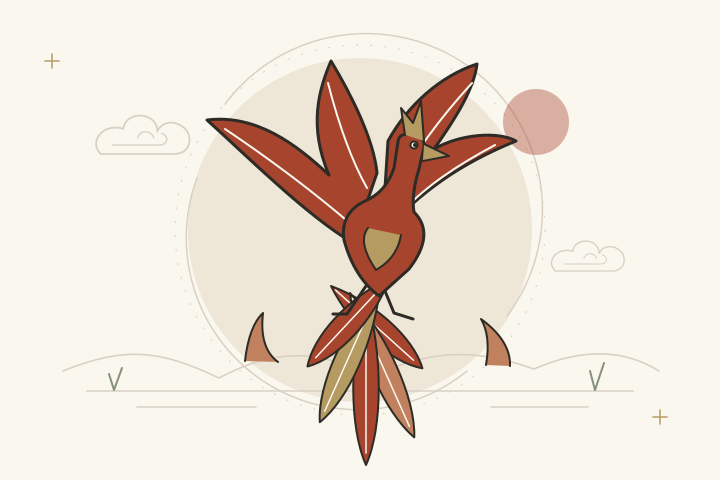
The fenghuang is an elegant mythical bird associated with virtue and a peaceful world. English often calls it a phoenix, but that translation can be misleading: the familiar story of burning and returning from ashes is not its defining ancient Chinese legend. Think brilliant plumage, graceful movement, and an appearance worth celebrating.
01 / THE PORTRAIT
Appearance
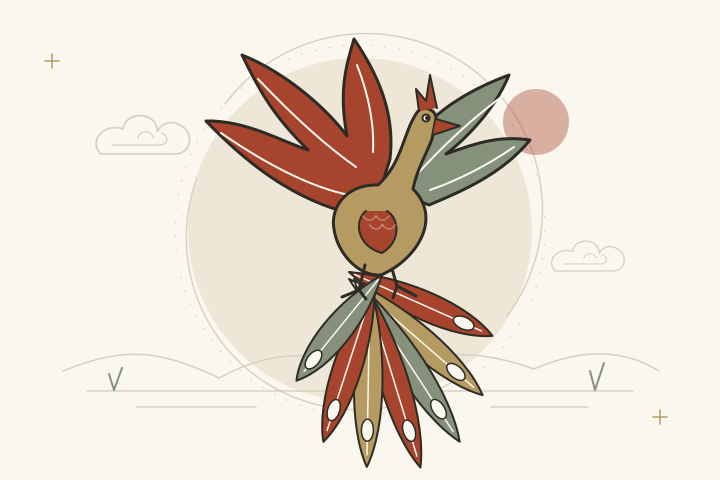
Artists commonly give the fenghuang a crested head, a curved neck, layered wings, and a spectacular flowing tail. Its colors and proportions vary with the medium, from woven silk to painted ceramics. In the Southern Mountains section of the Classic of Mountains and Seas, the bird is compared to a chicken and has multicolored markings linked with moral qualities. That brief description is different from a complete modern character design. Our illustration uses a sweeping tail and decorative feathers to make a recognizable contemporary interpretation. Flames can be an artistic choice, but they should not automatically imply that this bird dies and resurrects like a Western phoenix.
02 / THE STORY
Origins & Legends
The Classic of Mountains and Seas places a bird called fenghuang on Mount Danxue. Its appearance signals peace, and its markings make virtue visible on its body. Rather than staging a dramatic battle, this passage imagines a wonderful creature whose arrival reveals that the world is in good order.
The Book of Songs offers another influential setting. In the poem Juan a, flying and singing fenghuang appear alongside praise for worthy people. A high ridge, morning sunlight, and flourishing trees surround the image. The bird belongs to a poetic argument about good government and valued companions, not a tale about resurrection.
Later decorative arts expanded these associations. An eighteenth-century silk panel in The Metropolitan Museum of Art presents several fenghuang in a garden, demonstrating that artists could use the bird in rich courtly compositions. The image also appears in marriage imagery and other wishes for harmony. These later settings add meanings without turning every ancient fenghuang into one fixed gender or one fixed partner for a dragon. The Vermilion Bird, Zhuque, shares a birdlike silhouette but has its own role as the guardian of the southern direction.
03 / THE MEANING
Cultural Significance
The fenghuang offers a particularly vivid way to picture moral beauty. Its elegant form makes qualities such as harmony and virtue visible in clothing, furnishings, and ceremonial art. Later dragon-and-fenghuang pairings can convey wishes for a harmonious marriage, while court works connect the bird with an ideal of prosperous rule. Neither use exhausts its meaning. A poem, a wedding decoration, and an imperial tapestry address different audiences. For an English-speaking reader, keeping the name fenghuang alongside phoenix helps preserve those distinctions. It also prevents a familiar European story from quietly replacing the Chinese traditions that gave this bird its identity.
04 / FOLLOW THE PAPER TRAIL
Ancient Sources
Original Chinese texts and source notes. A later legend is not evidence of an ancient account; surviving editions may preserve material from different periods.
Ancient text
Classic of Mountains and Seas — Southern Mountains, Mount Danxue
山海經·南山經
The Danxue passage describes a multicolored, chickenlike fenghuang whose appearance accompanies peace.
Ancient text
Book of Songs — Juan a
詩經·大雅·卷阿
The poem uses flying and singing fenghuang in its praise of worthy companions and leadership.
Later tradition
Panel with Five Phoenixes in a Garden — The Metropolitan Museum of Art
An eighteenth-century silk tapestry, object 25.109.2, illustrating later court imagery and the distinction from the Western phoenix.
05 / SMALL SURPRISES
Fun Facts
Fenghuang is often translated as phoenix, but rising from ashes is not the defining story in the early sources linked here.
The Southern Mountains passage connects the bird’s markings with moral qualities.
The Book of Songs places singing fenghuang near flourishing trees and morning sunlight.
Zhuque and fenghuang are useful to compare, but they are not interchangeable names in every tradition.
Retold in English by LET.AC with AI assistance. Mythology has many versions; this entry follows the source notes above.