THE MYTHOLOGY FIELD GUIDE 03
Divine Beasts
Qilin
麒麟Qílín
The qilin is a wondrous hoofed creature linked with benevolence and auspicious appearances. It looks formidable in many later illustrations, yet its reputation emphasizes gentleness. Sometimes nicknamed the Chinese unicorn, it has a richer and more variable identity than that comparison suggests, from early poetry to unexpected encounters with real giraffes.
01 / THE PORTRAIT
Appearance
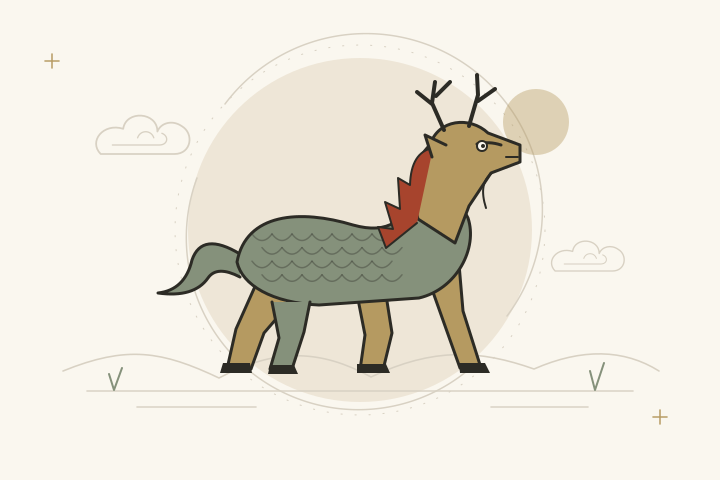
Qilin images often combine a hoofed, deerlike body with scales, a dramatic mane, a dragonlike face, and one or more horns. Different periods do not agree on a single anatomical recipe. The early poem Lin zhi zhi mentions the creature’s feet, forehead, and horn without supplying the elaborate details of a modern fantasy illustration. Later artists could make it slender and deerlike or much more muscular and dragonlike. Our depiction follows the modern composite tradition and should not be mistaken for a reconstruction of the earliest image. Even the unicorn comparison is approximate: a single horn is important in some accounts, while other artworks show paired or branching horns.
02 / THE STORY
Origins & Legends
The Book of Songs includes Lin zhi zhi, a short poem that invokes the lin while praising a noble family. Its animal imagery helped later readers connect the creature with considerate conduct. The Book of Rites also places the lin among four spiritually significant creatures, alongside the fenghuang, tortoise, and dragon. This grouping differs from the four directional guardians.
A more sorrowful tradition surrounds the capture of a lin. The Spring and Autumn Annals records a western hunt that obtained one in the fourteenth year of Duke Ai. The Gongyang commentary interprets the creature as benevolent and connects the event with Confucius’s grief. The entry and its interpretation are distinct textual layers; neither verifies that a mythical species existed.
Much later, giraffes presented to the Ming court were celebrated as qilin. That episode shows people interpreting an unfamiliar real animal through a prestigious mythical category. It does not mean all earlier qilin descriptions were secretly zoological reports about giraffes. The long history of the creature is especially interesting because poetry, moral commentary, diplomatic display, and artistic imagination each produced a different kind of evidence.
03 / THE MEANING
Cultural Significance
The qilin joins impressive strength with an ideal of restraint. That combination makes it well suited to wishes for good leadership, distinguished children, or an auspicious occasion. Later images can be fierce enough to guard a doorway while still referring to a creature praised for benevolence. The Ming giraffe episode also makes the qilin a useful reminder that cultural categories shape how people understand new experiences. A visitor can admire a beautiful sculpture and ask both what it depicts and what its owner hoped it would communicate. Gentleness, prestige, and good fortune are recurring themes, though individual objects require their own context.
04 / FOLLOW THE PAPER TRAIL
Ancient Sources
Original Chinese texts and source notes. A later legend is not evidence of an ancient account; surviving editions may preserve material from different periods.
Ancient text
Book of Songs — Lin zhi zhi
詩經·周南·麟之趾
A short poem invoking the lin’s feet, forehead, and horn in praise of a noble family.
Ancient text
Gongyang Commentary — Duke Ai, Year 14
春秋公羊傳·哀公十四年
Interprets the Annals’ capture of a lin as an exceptional event and associates it with Confucius’s grief.
Ancient text
Book of Rites — Li yun
禮記·禮運
Names the lin, fenghuang, tortoise, and dragon as four spiritually significant creatures.
Later tradition
The Giraffe as the Mythical Qilin in Chinese Art — Metropolitan Museum Journal
Museum research on the later identification of giraffes with qilin and the changing visual tradition.
05 / SMALL SURPRISES
Fun Facts
The early poem Lin zhi zhi is only three short stanzas long.
The Book of Rites groups the lin with the fenghuang, tortoise, and dragon; this is a different group from the four directional guardians.
Giraffes brought to the Ming court were interpreted and celebrated as qilin.
The nickname Chinese unicorn is convenient, but historical qilin images do not all share one horn arrangement.
Retold in English by LET.AC with AI assistance. Mythology has many versions; this entry follows the source notes above.