THE MYTHOLOGY FIELD GUIDE 06
Legendary Animals
Pixiu
貔貅Píxiū
Today’s pixiu is a fierce-looking guardian often associated with attracting and keeping wealth. Its ancient name has a more complicated past: early texts mention formidable beasts, not a complete instruction manual for money charms. The familiar creature with a dragonlike head and generous appetite belongs to a much later, evolving visual and popular tradition.
01 / THE PORTRAIT
Appearance
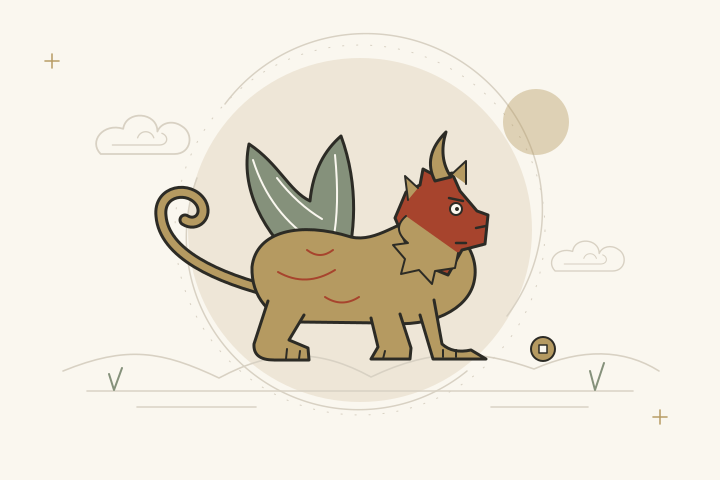
Modern pixiu ornaments commonly show a compact, powerful quadruped with a dragonlike head, a large mouth, and curled decorative features. Some designs include wings or horns, while others resemble a lion more closely. These forms overlap with the broad family of Chinese guardian-beast imagery, so a sculpture’s name cannot always be settled by looks alone. The Shiji’s early reference does not describe this full modern appearance. Our illustration uses a stout body and expressive face to convey the contemporary guardian image. Gold coloring and a nearby coin are modern symbols of its popular wealth association, rather than details established by the ancient passage.
02 / THE STORY
Origins & Legends
In the Shiji’s account of the Yellow Emperor, pi and xiu appear among formidable beasts trained for a conflict at Banquan. Reading the names as two animals or as a later combined creature requires care: ancient word use does not automatically match the pixiu figurine on a modern bracelet. The account itself belongs to a legendary founding narrative, not a verified military report involving supernatural animals.
In current popular folklore, pixiu eats treasure and keeps it inside its body. One widely repeated explanation says that it has no anus, allowing riches to enter without leaving. The exact origin of that explanation is uncertain; it should not be credited to the Shiji or presented as a securely dated ancient teaching. Stories about punishment by a heavenly ruler likewise need a named source before they can be assigned to a particular period.
Modern owners may choose a pixiu charm as a wish for prosperity or protection. Different sellers and communities supply different rules for handling or positioning it. Those rules describe living belief and commercial practice; they do not form one universally accepted mythical biography.
03 / THE MEANING
Cultural Significance
Pixiu makes a familiar wish tangible: may good things arrive, and may they stay. Its popularity in ornaments, bracelets, and decorative objects shows how old creature names can acquire new emphasis. The wealth-eating story is an especially memorable piece of modern folklore, although a memorable explanation is not the same as an ancient citation. Reading a pixiu object as an expression of hope helps explain its appeal without treating it as a promise of financial results. It also leaves room to appreciate the carving, the owner’s personal meaning, and the many local variations that a standardized online description often smooths away.
04 / FOLLOW THE PAPER TRAIL
Ancient Sources
Original Chinese texts and source notes. A later legend is not evidence of an ancient account; surviving editions may preserve material from different periods.
Ancient text
Records of the Grand Historian — The Five Emperors, Volume 1
史記·五帝本紀
The Yellow Emperor passage names pi and xiu among beasts trained for Banquan. It does not establish today’s wealth-retention story or figurine anatomy.
Modern folklore / uncertain origins
Popular wealth-charm folklore — origin uncertain
The treasure-eating and no-anus explanation is a widely circulated later belief. No securely verified early text is assigned to it here.
05 / SMALL SURPRISES
Fun Facts
The Shiji names pi and xiu in a list of formidable beasts in the Yellow Emperor narrative.
The popular treasure-retention story, including the no-anus explanation, has an uncertain textual origin.
Modern pixiu designs may overlap visually with lions and other guardian beasts.
Rules for placing or wearing pixiu vary; they are not supplied by the ancient Shiji passage.
Retold in English by LET.AC with AI assistance. Mythology has many versions; this entry follows the source notes above.