THE MYTHOLOGY FIELD GUIDE 13
Monsters
Nian
年兽Nián
Nian is the New Year monster of a familiar modern folktale: a terrifying visitor outwitted by red decorations, bright fire, and loud noise. It makes a memorable festival story, but the tale's earliest source remains uncertain. Older records of protective New Year customs deserve their own separate history and should not be confused with the beast's biography.
01 / THE PORTRAIT
Appearance
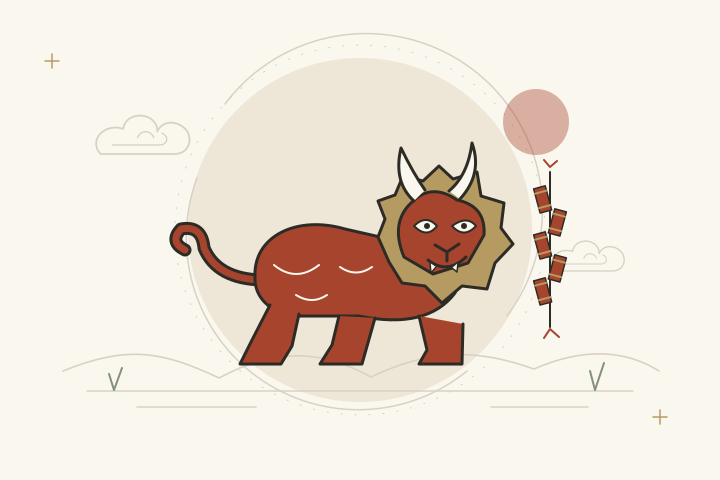
Nian has no securely documented ancient model sheet. Modern tellings and illustrations often present a large, ferocious creature with a broad mouth, sharp teeth, and powerful claws. Horns, shaggy fur, and a lionlike head are optional choices that vary between storytellers. Some pictures make it frightening; children's versions may make it almost cuddly, particularly once it discovers that a village can be louder than a monster. Our illustration is one contemporary interpretation of that flexible appearance. Neither a particular coat color nor the number of horns should be treated as a detail inherited from an identified classical description.
02 / THE STORY
Origins & Legends
In a familiar version of the story, a beast arrives at the end of the year and threatens a village. An old visitor reveals that it fears red, fire, and loud sounds. The villagers decorate their homes and make a tremendous racket, turning fear into celebration. The Singapore Chinese Cultural Centre's modern teaching materials tell a version in which the community works together to frighten Nian away.
The story is widely repeated as an explanation of New Year practices, but that does not establish that the practices began with a belief in this particular monster. The tale's earliest origin remains uncertain. It should be introduced as modern popular folklore rather than assigned an invented ancient date or author.
There are genuine older records of related customs. The sixth-century Jingchu Suishiji describes burning bamboo at the New Year to ward off shanxiao and harmful spirits. That passage supports a history of protective noise-making, but it does not name a beast called Nian. Reading the two side by side reveals how a later explanatory tale can gather recognizable customs into one memorable adventure.
03 / THE MEANING
Cultural Significance
Nian turns a festival's colors and sounds into a story that children can retell. Its defeat celebrates cleverness and cooperation: a village discovers that shared action can overcome a frightening visitor. Modern educational versions use the tale to introduce lanterns, red decorations, and festive noise. That value does not depend on pretending that every custom has one documented mythical origin. Keeping the storytelling and historical evidence distinct lets both remain interesting. Enjoy Nian as a popular festival character, then notice how much richer New Year becomes when its many practices are allowed to have different histories and meanings.
04 / FOLLOW THE PAPER TRAIL
Ancient Sources
Original Chinese texts and source notes. A later legend is not evidence of an ancient account; surviving editions may preserve material from different periods.
Ancient text
Jingchu Suishiji — New Year customs; context only
《荊楚歲時記》正月一日條
Sixth-century account of burning bamboo to ward off shanxiao and harmful spirits. Evidence for an older custom, not an ancient attestation of the Nian beast.
Modern folklore / uncertain origins
Singapore Chinese Cultural Centre — The Learning Kid, Annex A
Modern educational retelling, published in 2021, on printed pages 10–11. Documents a contemporary Nian story; it does not establish an ancient origin.
05 / SMALL SURPRISES
Fun Facts
Nian, 年, is the ordinary Chinese word for year; the creature is usually called nianshou, 年兽, or year beast.
The older Jingchu Suishiji passage mentions shanxiao and harmful spirits, not a monster named Nian.
Modern versions vary in the monster's appearance and in whether it comes from mountains or the sea.
The Singapore Chinese Cultural Centre presents a teaching version centered on villagers working together.
Retold in English by LET.AC with AI assistance. Mythology has many versions; this entry follows the source notes above.