THE MYTHOLOGY FIELD GUIDE 05
Monsters
Taotie
饕餮Tāotiè
Taotie has an appetite big enough to become a moral lesson. The name is also used for staring animal-face designs on ancient bronzes, although that label was applied after many of the objects were made. A hungry monster, a warning about greed, and an archaeological motif meet here without being exactly the same thing.

01 / THE PORTRAIT
Appearance
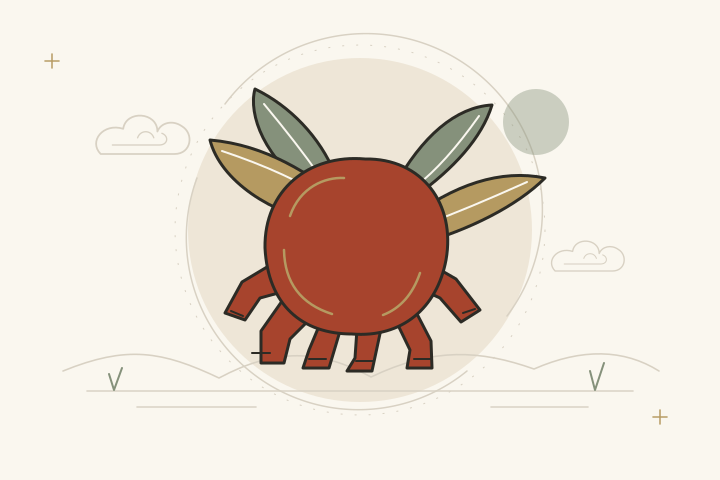
The bronze design commonly called a taotie presents a face looking straight at the viewer, with prominent eyes and roughly mirrored sides. Horns, brows, jaws, and surrounding curls differ between objects; sometimes the lower jaw is absent. A complete body is often hard to locate, which contributes to the masklike effect. Later literature’s head without a body offers another image, but it does not prove what every Bronze Age artist intended. Modern fantasy artists may add legs, jaws, or an enormous stomach. Our illustration emphasizes the staring, symmetrical face as a contemporary interpretation of the motif, rather than inventing one definitive ancient monster anatomy.
02 / THE STORY
Origins & Legends
The Lüshi Chunqiu’s Xianshi section describes a taotie represented on Zhou cauldrons: it has a head without a body, attempts to devour a person, and brings harm upon itself. The passage uses the creature to illustrate consequences, placing monstrous appetite inside an argument about conduct.
The Zuo Commentary offers another layer. In the eighteenth year of Duke Wen, taotie is a condemning name given to a figure associated with greed for food and possessions. The account groups four harmful lineages, including Hundun, Qiongqi, and Taowu. It does not simply supply a zoological catalogue of four monsters with matching bodies.
Meanwhile, the animal-face patterns on Shang and Zhou bronzes predate many surviving explanations. Museums use taotie as a convenient conventional name, but the original meanings of individual designs remain debated. A staring face might have communicated ritual power, protection, or something no longer recoverable. Separating the ancient object, the later written explanation, and today’s fantasy creature leaves room for the uncertainty that makes these designs fascinating. The bronze is real; the creature and its appetite belong to interpretation and myth.
03 / THE MEANING
Cultural Significance
Taotie links a visually powerful motif with a lasting criticism of excessive appetite. The word can evoke someone who eats greedily, but the bronze masks belong to objects used in serious ritual and elite display. Reducing those objects to illustrations of a comic glutton would miss much of their context. Their balanced shapes and staring eyes also provide striking material for contemporary design. A museum visitor can enjoy the recognizable face while keeping the historical question open: a label helps us discuss a pattern, but it does not recover every meaning that pattern held for the people who first made it.
04 / FOLLOW THE PAPER TRAIL
Ancient Sources
Original Chinese texts and source notes. A later legend is not evidence of an ancient account; surviving editions may preserve material from different periods.
Ancient text
Lüshi Chunqiu — Volume 16, Xianshi
呂氏春秋·先識
Describes the head without a body on Zhou cauldrons and uses its self-destructive appetite as a moral example. Linked edition includes later commentary.
Ancient text
Zuo Commentary — Duke Wen, Year 18
春秋左傳·文公十八年
Uses taotie as a name condemning greed and includes it among four harmful lineages. Linked edition includes commentary.
Later tradition
Taotie — British Museum Collection Glossary
Museum terminology explaining the symmetrical animal-face motif and the later application of the name.
05 / SMALL SURPRISES
Fun Facts
The familiar bronze taotie is often a face, rather than an easily identifiable complete animal.
The name was applied to the motif later than the production of many Shang bronzes.
The Lüshi Chunqiu describes a head without a body as a warning about harmful conduct.
The Zuo Commentary connects taotie with the same four harmful lineages as Hundun, Qiongqi, and Taowu.
Retold in English by LET.AC with AI assistance. Mythology has many versions; this entry follows the source notes above.