THE MYTHOLOGY FIELD GUIDE 15
Monsters
Qiongqi
穷奇Qióngqí
Qiongqi is a dangerous creature whose ancient portraits refuse to agree: one looks like a bristling ox, another like a winged tiger. A later account makes it a champion of the wrong side, rewarding wickedness and attacking the innocent. It is a memorable example of mythology preserving alternatives instead of one official design.
01 / THE PORTRAIT
Appearance
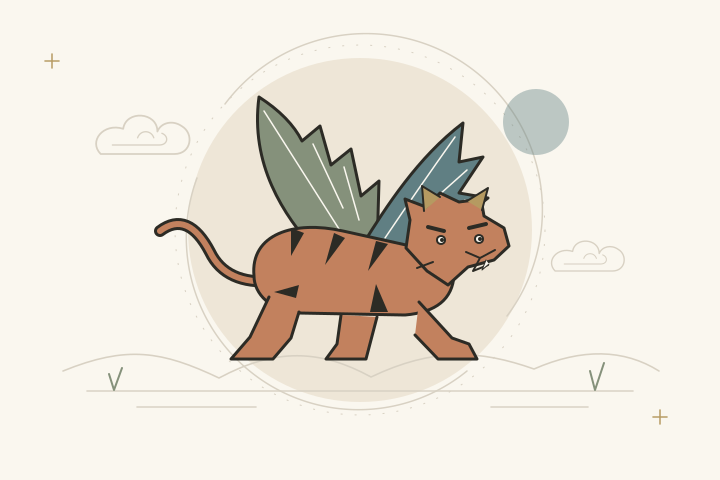
The Western Mountains section of the Classic of Mountains and Seas describes Qiongqi as oxlike, with hedgehoglike hair and a doglike cry. The Northern Regions Within the Seas section instead gives it a tiger's form and wings. Both passages describe a creature that eats people, but their silhouettes are strikingly different. A later Shenyijing account develops the flying tiger image. Modern artists often favor that dramatic shape, adding muscular limbs and broad wings. Our illustration follows the winged interpretation. A bristling ox is equally relevant to the older textual record; neither description requires pretending that all the conflicting features originally appeared together.
02 / THE STORY
Origins & Legends
Qiongqi appears in several traditions with different purposes. In the Classic of Mountains and Seas, it is one of the dangerous beings encountered in the text's extraordinary geography. The Western Mountains passage places the oxlike version on Mount Gui, while another section describes a winged tiger. These are alternative textual descriptions, not stages in an explicitly narrated transformation.
The Zuo Tradition gives the name a moral setting. In its account under Duke Wen's eighteenth year, Qiongqi designates an unworthy son or clan associated with slander and the destruction of loyalty. It appears alongside Hundun, Taowu, and Taotie in the Four Evils tradition. That passage does not describe a tiger with wings.
The later Shenyijing brings animal form and moral perversity together. Its Qiongqi can understand speech and, when people quarrel, attacks the person in the right; it favors the wicked instead. The collection's authorship and date are uncertain, so it should not be treated as a securely identified Han eyewitness source. These versions give modern storytellers several starting points: a wilderness predator, a name for corrupt conduct, or a monster that turns justice upside down.
03 / THE MEANING
Cultural Significance
Qiongqi is especially effective as an image of injustice because its later behavior reverses what a helpful guardian should do. Honesty becomes dangerous, while wrongdoing receives support. Read beside Xiezhi, the beast that identifies guilt, it creates a striking imaginative contrast between moral confusion and moral discernment. Its changing body also teaches a useful lesson about Chinese mythology: a name can travel between geographical marvels, political judgments, and supernatural tales. Understanding that movement is more rewarding than choosing one image and declaring the others mistakes. The contradictions are part of the creature's history, and part of its continuing dramatic potential.
04 / FOLLOW THE PAPER TRAIL
Ancient Sources
Original Chinese texts and source notes. A later legend is not evidence of an ancient account; surviving editions may preserve material from different periods.
Ancient text
Classic of Mountains and Seas — Western Mountains
《山海經·西山經》邽山條
Describes an oxlike Qiongqi with hedgehoglike hair, a doglike voice, and a habit of eating people.
Ancient text
Classic of Mountains and Seas — Northern Regions Within the Seas
《山海經·海內北經》
Offers the distinct tigerlike, winged description. The text does not reconcile this with the bristled ox image.
Ancient text
Zuo Tradition — Duke Wen, Year 18
《春秋左氏傳·文公十八年》
Places Qiongqi among the Four Evils as a designation for an unworthy son or clan associated with slander and disloyalty.
Later tradition
Shenyijing — Northwestern Wilderness
《神異經·西北荒經》
Describes a flying tigerlike monster that attacks the innocent and supports wicked people; traditional authorship is disputed.
05 / SMALL SURPRISES
Fun Facts
The Classic of Mountains and Seas preserves both an oxlike Qiongqi and a winged tiger version.
Its bristled ox description appears in the Western Mountains section, not the Northern Mountains section.
The Zuo Tradition's Four Evils passage condemns conduct and clans without giving Qiongqi wings.
In the later Shenyijing version, Qiongqi perversely sides with the person in the wrong.
Retold in English by LET.AC with AI assistance. Mythology has many versions; this entry follows the source notes above.