THE MYTHOLOGY FIELD GUIDE 14
Spirits
Hundun
混沌Hùndùn
Hundun brings a strange philosophical warning: good intentions can ruin what they do not understand. In the Zhuangzi, a hospitable ruler without the usual human openings dies when friends try to improve him. Other texts give similarly named figures different roles. The famous faceless shape is a tradition with layers, not one consistent monster biography.
01 / THE PORTRAIT
Appearance
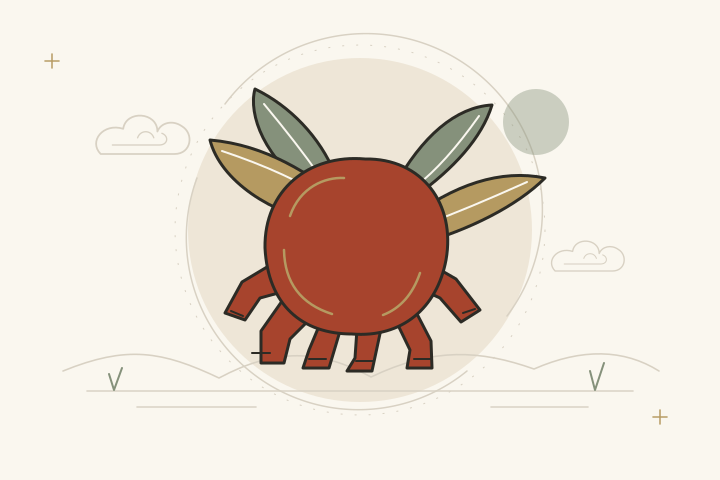
The Zhuangzi tells us that Hundun lacks the seven human openings used for seeing, hearing, eating, and breathing. It does not supply wings, a color, or a precise body shape. Rounded, faceless modern drawings translate that absence into a visible character. A related but distinct description in the Classic of Mountains and Seas belongs to Dijiang: a sacklike divine being with six feet, four wings, and no recognizable face. The commentary printed with that passage connects it to the Zhuangzi's story. Later accounts also describe a doglike Hundun. These images can inform art, but combining every feature into one ancient creature would hide their differences. Our illustration explicitly borrows Dijiang's six feet and four wings; these are not anatomy specified by the Zhuangzi.
02 / THE STORY
Origins & Legends
At the end of the Zhuangzi's Responding to Emperors and Kings, rulers of the southern and northern seas visit Hundun, ruler of the center. He treats them kindly. To repay him, they decide to give him the seven openings that human beings possess. They make one opening each day; on the seventh day, Hundun dies. The narrative can be read as a warning against forcing one's own idea of improvement onto another being.
Other textual traditions should be kept separate. The Zuo Tradition uses a related name for a morally condemned son or clan among the Four Evils. The Classic of Mountains and Seas calls its faceless, dancing, six-footed and four-winged deity Dijiang. A commentary links that figure with the Zhuangzi's Hundun, but the main passage does not simply give the two an identical name.
The later Shenyijing offers yet another version: a strange doglike creature that favors bad people. Its traditional authorship is disputed. Modern depictions can draw on these overlapping associations, but the kindly philosophical ruler and the hostile moral monster do not have the same role. Following those differences makes Hundun much more intriguing.
03 / THE MEANING
Cultural Significance
Hundun invites readers to question the impulse to classify, correct, and remodel everything they encounter. The Zhuangzi's story is unsettling because the visitors mean well: their mistake is assuming that their host should function like them. That makes the tale useful for thinking about difference, intervention, and the limits of knowledge. The word hundun also evokes an undifferentiated or confused state, which helps explain its appeal in imaginative depictions of primordial chaos. Yet the character is more than a convenient villain called Chaos. In its most memorable literary appearance, the supposedly incomplete being is the generous host, while improvement supplies the tragedy.
04 / FOLLOW THE PAPER TRAIL
Ancient Sources
Original Chinese texts and source notes. A later legend is not evidence of an ancient account; surviving editions may preserve material from different periods.
Ancient text
Zhuangzi — Responding to Emperors and Kings
《莊子·應帝王》
The closing parable describes the central ruler Hundun and the fatal attempt to give him seven human openings.
Ancient text
Classic of Mountains and Seas — Western Mountains; Dijiang comparison
《山海經·西山經》天山條
Names the faceless, six-footed and four-winged deity Dijiang. The printed commentary relates it to Hundun; the main text names a distinct figure.
Ancient text
Zuo Tradition — Duke Wen, Year 18
《春秋左氏傳·文公十八年》
Uses a related name for a condemned son or clan within the Four Evils tradition, rather than the kindly ruler of the Zhuangzi.
Later tradition
Shenyijing — Western Wilderness
《神異經·西荒經》
A later doglike Hundun favors wicked people. The collection's traditional attribution to Dongfang Shuo is disputed.
05 / SMALL SURPRISES
Fun Facts
The Zhuangzi's Hundun is a ruler of the center and a considerate host.
The seven openings are two eyes, two ears, two nostrils, and a mouth.
Dijiang is the name used by the Classic of Mountains and Seas for its faceless being with six feet and four wings.
Historical texts use several related written forms, including 渾沌 and 渾敦.
Retold in English by LET.AC with AI assistance. Mythology has many versions; this entry follows the source notes above.