THE MYTHOLOGY FIELD GUIDE 12
Legendary Animals
Kunpeng
鲲鹏Kūnpéng
Kunpeng begins as an unimaginably large fish and becomes a bird whose wings resemble clouds hanging across the sky. The transformation opens the Zhuangzi, where impossible scale invites readers to reconsider their own perspective. This is mythology with a philosophical question attached: how much of the world can a small viewpoint understand?
01 / THE PORTRAIT
Appearance
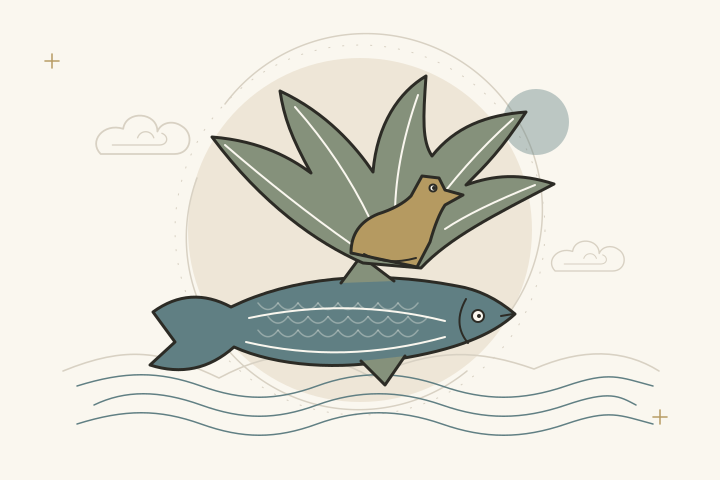
Kun is an enormous fish in the northern sea; Peng is its equally enormous bird form. The Zhuangzi describes their size through vast distances and cloudlike wings rather than identifiable species. It does not give Kun a fixed pattern of scales or specify that Peng must have an eagle's head. Artists therefore choose details that communicate immensity: a fish disappearing beneath ocean waves, or a bird stretching beyond a mountain horizon. A combined fish and bird image represents the transformation for convenience. It should not suggest that the original text describes a permanent hybrid with fins on one side and feathers on the other.
02 / THE STORY
Origins & Legends
The opening of the Zhuangzi's Free and Easy Wandering tells of Kun, a fish in the northern depths, changing into Peng. When the seas stir, the great bird prepares to travel south. Its ascent and journey require immense winds: even a magnificent creature depends on conditions that support it.
Smaller flying creatures laugh at the journey because their own flights go little farther than nearby trees. The contrast invites a change of perspective. What seems absurd from one scale may make sense from another, while Peng's dependence on wind complicates any simple claim that being enormous means being completely free. These are philosophical images, not records of an observed animal.
Later literature gave Peng a more personal role as an emblem of ambition. In his poem Addressed to Li Yong, the Tang poet Li Bai invokes the great bird's soaring flight to express confidence in his own possibilities. That literary use helps explain why the image can feel inspirational today. Kunpeng thus carries two related but different inheritances: the Zhuangzi's unsettling questions about perspective and freedom, and later poetry's vision of rising beyond present limits.
03 / THE MEANING
Cultural Significance
Kunpeng offers a particularly vivid way to think about transformation. The fish does not merely grow larger: its relationship with the world changes from swimming through water to flying across the sky. Readers can take inspiration from that leap without forgetting the original chapter's playful skepticism. Li Bai's great bird shows how a philosophical image can become a poet's declaration of ambition. The combination is part of Kunpeng's appeal: enormous possibilities, enormous distances, and a tiny reader trying to imagine them. When you encounter this creature, its most interesting power may be enlarging the questions you are willing to ask.
04 / FOLLOW THE PAPER TRAIL
Ancient Sources
Original Chinese texts and source notes. A later legend is not evidence of an ancient account; surviving editions may preserve material from different periods.
Ancient text
Zhuangzi — Free and Easy Wandering
《莊子·逍遙遊》
The opening passage introduces Kun changing into Peng and contrasts the great bird's journey with smaller creatures' perspectives.
Later tradition
Li Bai — Addressed to Li Yong
李白《上李邕》
A Tang poem that reuses the great bird's ascent to express the speaker's ambition; a later literary interpretation of the image.
05 / SMALL SURPRISES
Fun Facts
Kun and Peng name the fish and bird forms, respectively; Kunpeng combines those two names.
The Zhuangzi compares Peng's wings to clouds suspended across the sky.
Peng needs a great accumulation of wind to support its vast wings, a detail with philosophical importance.
Li Bai uses the great bird in Addressed to Li Yong as an image of soaring ambition.
Retold in English by LET.AC with AI assistance. Mythology has many versions; this entry follows the source notes above.