THE MYTHOLOGY FIELD GUIDE 19
Legendary Animals
Jingwei
精卫Jīngwèi
Jingwei is a small bird with a task bigger than any ocean: carrying wood and stones to fill the sea that drowned her. The Classic of Mountains and Seas identifies her as the transformed daughter of the Flame Emperor. Her story holds grief and determination together, making every tiny delivery feel unexpectedly powerful.
01 / THE PORTRAIT
Appearance
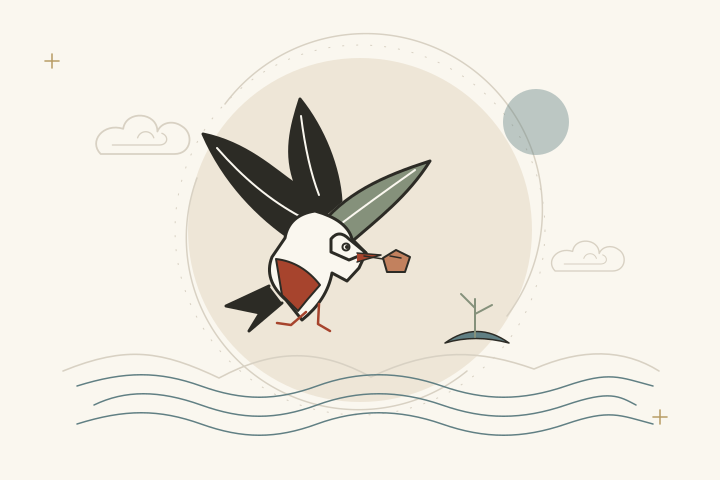
The Classic of Mountains and Seas describes Jingwei as resembling a crow, with a patterned head, a white beak, and red feet. Those modest features are essential to the story's contrast between a small creature and a vast sea. She is often pictured with a twig or pebble in her beak, a visual shorthand for her repeated journeys. Our illustration uses that storytelling detail in a modern stylized form. Elaborate plumage, a human body with wings, or a royal crown would be creative additions rather than parts of this passage's description. Jingwei's most important visual attribute is her scale: she remains a bird facing an ocean.
02 / THE STORY
Origins & Legends
In the Northern Mountains section of the Classic of Mountains and Seas, Jingwei lives on Mount Fajiu. The text identifies her as Nüwa, the youngest daughter of the Flame Emperor. This Nüwa, written 女娃, should not be confused with the better-known creator goddess Nüwa, written 女媧. The daughter swims or travels in the Eastern Sea, drowns, and becomes the bird Jingwei.
She repeatedly carries wood and stones from the western mountains to fill the Eastern Sea. The passage gives us the action without a cheerful scene in which the enormous project is completed. Its force lies in the imbalance: an injured individual answers a vast, indifferent sea with continuing effort.
Later literature drew new meanings from this short account. In the tenth poem of his Reading the Classic of Mountains and Seas sequence, Tao Yuanming places Jingwei beside Xingtian, another figure of unbroken resolve. That pairing emphasizes persistence beyond bodily defeat. Modern retellings may celebrate determination, protest against injustice, or sympathy for the drowned girl. Those are interpretations of a powerful ancient image; they should not replace the original story's grief with an invented guaranteed victory.
03 / THE MEANING
Cultural Significance
Jingwei's story invites admiration without removing its sadness. The familiar phrase Jingwei fills the sea evokes determined effort in the face of an overwhelming task. Tao Yuanming's poem shows that readers were already finding heroic resolve in this tiny bird many centuries ago. Yet perseverance is only one way to read the tale: its starting point is a young girl's loss, and the repeated action can also express grief or resistance. For newcomers, Jingwei offers an accessible doorway into Chinese mythology because the central image needs very little explanation. A small bird carries one stone, and the ocean still waits.
04 / FOLLOW THE PAPER TRAIL
Ancient Sources
Original Chinese texts and source notes. A later legend is not evidence of an ancient account; surviving editions may preserve material from different periods.
Ancient text
Classic of Mountains and Seas — Northern Mountains
《山海經·北山經》發鳩山條
Describes the bird's appearance, identifies her as the Flame Emperor's drowned daughter 女娃, and recounts her carrying wood and stones to the sea.
Later tradition
Tao Yuanming — Reading the Classic of Mountains and Seas, Poem 10
陶淵明《讀山海經十三首》其十
An early fifth-century literary response that pairs Jingwei's effort with Xingtian's resolve; a later interpretation of the mountain classic.
05 / SMALL SURPRISES
Fun Facts
Jingwei's former name is 女娃, distinct from 女媧, the name of the creator goddess often romanized the same way.
The ancient description gives her a white beak and red feet.
She brings wood and stones from the western mountains to the Eastern Sea.
Tao Yuanming pairs Jingwei with Xingtian in the tenth poem of his Reading the Classic of Mountains and Seas sequence.
Retold in English by LET.AC with AI assistance. Mythology has many versions; this entry follows the source notes above.