THE MYTHOLOGY FIELD GUIDE 04
Spirits
Nine-Tailed Fox
九尾狐Jiǔwěihú
Nine tails make this fox easy to recognize, but they do not guarantee a friendly personality. An early mountain text describes a dangerous creature, while later literature develops powerful fox spirits and human disguises. Modern stories may turn it into a romantic hero, a cunning villain, or an adorable companion with serious tail-management problems.
01 / THE PORTRAIT
Appearance
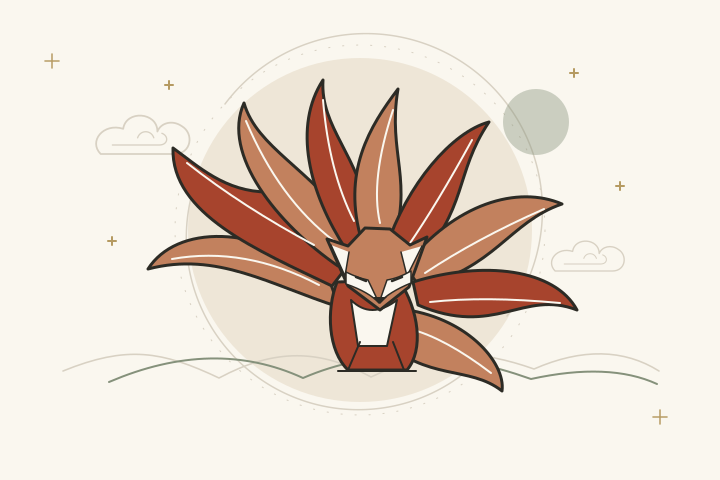
The most consistent identifying feature is a foxlike animal with nine tails. The Southern Mountains account also gives it a cry resembling an infant’s, which makes the encounter rather less cuddly than its modern plush-toy image. That passage does not prescribe white fur, glowing markings, or a human costume. Later illustrators and storytellers supply those details in different ways. In stories involving transformation, the fox can appear as a human, so an attractive person may conceal its supernatural identity. Our illustration keeps the nine tails visible as a modern visual shorthand. A fan of tails conveys the idea clearly without claiming that ancient authors specified this exact pose or color.
02 / THE STORY
Origins & Legends
The Classic of Mountains and Seas places a nine-tailed fox at Qingqiu in its Southern Mountains section. The creature can eat people, so the early passage is a warning-laden description of a strange place rather than a romance about a misunderstood spirit. Other passages in the same collection locate foxes with nine tails in the broader imagined geography of Qingqiu.
Later fiction tells different stories. In the Ming novel Investiture of the Gods, a fox spirit inhabits the role of Daji and participates in the downfall of the Shang ruler. The novel’s late chapters explicitly call it a nine-tailed fox spirit. This is literary supernatural storytelling, not evidence that the historical Daji was a fox or that women caused dynastic collapse through magical seduction.
Fox tales continued to change across East Asia, and modern games and television select different parts of that inheritance. Not every Chinese fox spirit has nine tails, and a nine-tailed character does not carry identical rules in every country. Treating the Qingqiu beast, a later court intruder, and a contemporary romantic character as separate versions makes the creature’s remarkable adaptability easier to appreciate.
03 / THE MEANING
Cultural Significance
Fox spirits let storytellers explore the unstable boundary between familiar and strange. They can make a trusted face suspicious, question appearances, or create sympathy for someone outside ordinary society. The nine-tailed fox’s changing roles also expose the assumptions of the stories that use it. Daji’s supernatural portrayal belongs to a later novel with its own politics and moral judgments; it should not become a factual description of a real woman. Modern adaptations frequently reconsider that villainous role. For new readers, following these shifts is more rewarding than deciding that every fox must be either a benevolent guardian or an irresistible deceiver.
04 / FOLLOW THE PAPER TRAIL
Ancient Sources
Original Chinese texts and source notes. A later legend is not evidence of an ancient account; surviving editions may preserve material from different periods.
Ancient text
Classic of Mountains and Seas — Southern Mountains, Qingqiu
山海經·南山經
Describes a foxlike creature with nine tails and an infantlike cry that can eat people.
Ancient text
Classic of Mountains and Seas — Eastern Regions Beyond the Seas
山海經·海外東經
The Qingqiu country passage separately mentions foxes with four feet and nine tails in its imagined geography.
Later tradition
Investiture of the Gods — Chapter 96
封神演義·第九十六回
A Ming fictional tradition: the pursuit of Daji and her companions explicitly identifies a nine-tailed fox spirit.
05 / SMALL SURPRISES
Fun Facts
The Southern Mountains text gives the creature an infantlike cry.
Qingqiu is a mythic place associated with nine-tailed foxes in the Classic of Mountains and Seas.
Investiture of the Gods is a much later novel, so its Daji story is not the origin of every fox tradition.
White fur is common in modern designs, but it is not specified in the early Qingqiu passage linked here.
Retold in English by LET.AC with AI assistance. Mythology has many versions; this entry follows the source notes above.