THE ART OF WAR CHAPTER 02
Waging War
作战篇
An undertaking consumes more than the effort at its front line.
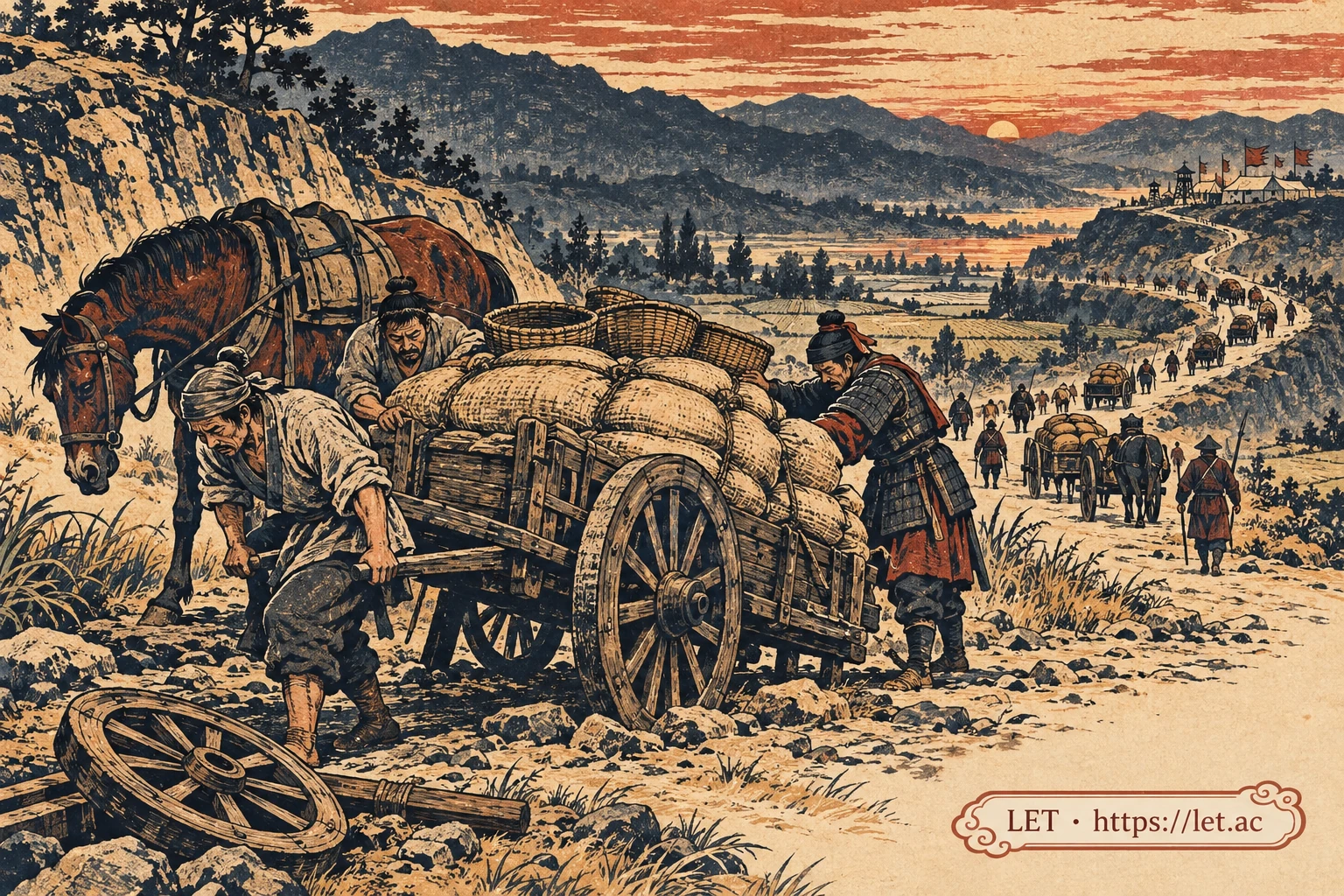
Sun Tzu turns from planning to the cost of action: supplies, transport, exhausted people, and the danger of a campaign that never ends. Read the complete second chapter with an independent English rendering, modern Chinese, bilingual commentary, and a fictional archive project that learns to finish.
01 / A reading of the text, with context.
1. Count the cost of beginning—and continuing
Sun Tzu says: To conduct a campaign with a thousand swift chariots drawn by four-horse teams, a thousand heavy wagons, a hundred thousand armored soldiers, and grain carried over a thousand li, one must meet expenses at home and in the field, provide for guests and envoys, supply glue and lacquer, and maintain vehicles and armor. Daily expenditure reaches a thousand units of money; only then can an army of a hundred thousand move. In conducting war, victory is what matters. If it drags on, weapons become blunt and fighting spirit weakens. Attacking fortified cities exhausts strength; keeping an army in the field for a long time leaves the state's resources insufficient. Once weapons are worn, resolve diminished, strength exhausted, and wealth consumed, other rulers will rise to exploit that weakness. Even someone wise cannot put the aftermath right. Thus I have heard of campaigns that were rough in execution but swift; I have never seen skill in a campaign's prolonged duration. There has never been a case of prolonged warfare benefiting a state. Those who do not fully understand the harm of using an army cannot fully understand its advantages either.
02 / A reading of the text, with context.
2. Avoid calling on the same people again and again
Those skilled in using an army do not levy people for service a second time or load grain for transport a third time. They obtain equipment and supplies from their own state and rely on the enemy for grain; in this way the army can have enough to eat.
03 / A reading of the text, with context.
3. Follow the burden all the way to households
A state is impoverished by supporting an army through long-distance transport; long-distance transport impoverishes the people. Near the army, goods are sold at high prices, and those high prices drain the people's resources. Once resources are depleted, the demands of local levies and service press harder. Strength is exhausted and wealth spent; households throughout the homeland are emptied. Of the people's resources, seven parts in ten are consumed. Of the state's resources—broken chariots, worn-out horses, armor and helmets, arrows and crossbows, halberds and shields, large protective shields, oxen levied from communities and heavy wagons—six parts in ten are consumed.
04 / A reading of the text, with context.
4. A supply is worth more when it is already where needed
Therefore, a wise commander makes a priority of obtaining food from the enemy. One zhong of the enemy's grain is worth twenty zhong supplied from our own side; one shi of their bean stalks and straw is worth twenty shi of ours.
05 / A reading of the text, with context.
5. Turn an outcome into capacity, and care for people
Thus anger drives soldiers to kill the enemy; material rewards move them to capture the enemy's resources. In chariot warfare, when ten or more enemy chariots are taken, reward those who took them first and replace the chariots' banners. Mix the captured chariots with our own and use them. Treat captured soldiers well and provide for them. This is called defeating the enemy while becoming stronger.
06 / A reading of the text, with context.
6. Seek a result that justifies the burden
Therefore, war values victory, not prolonged duration. A commander who understands warfare holds the people's lives in their keeping and bears responsibility for the state's safety or peril.
PAUSE & CONSIDER
Ideas to keep
- Include supply, transport, maintenance, and support work when judging the cost of action.
- Understand the harm an undertaking can cause before claiming its benefits.
- Notice repeated demands on people; another extension may reveal an unfinished plan.
- Make resources available where they are needed, through arrangements everyone has agreed.
- Define a useful finish, preserve what the work creates, and give people a workable handover.
AN ILLUSTRATIVE MODERN SCENARIO
A neighborhood archive: an illustrative fictional scenario
A volunteer group agrees to make a searchable inventory of donated neighborhood newsletters. The initial task covers twenty boxes, with a title, date, and shelf location for each issue. As work begins, appealing additions arrive: scan every page, write biographies of every contributor, and trace each street name. The group keeps accepting them. After several extensions, there are many half-finished records and no catalog that the archive's visitors can use.
The coordinator traces the continuing cost. One volunteer travels across town to fetch boxes; another repeatedly explains changing rules to newcomers. A third spends each session correcting fields added the previous week. People are also postponing family time and other commitments. Recording these support tasks makes the burden visible. The team returns to its original purpose: help visitors find an issue without opening every box. They agree to finish the twenty-box inventory first and put scanning and research into a separate list for a later decision.
With the archive custodian's permission, the group works at a shared table beside the collection. A simple field guide, an existing computer, and a common list of shelf labels are available there. Boxes stay in the archive instead of circulating between homes. This reduces journeys, setup, and incompatible copies. The team uses a small sample to confirm that the description rules work, then checks uncertain dates and locations in pairs. They keep the checks that make the inventory trustworthy even as they narrow the scope.
The team defines completion as every issue in the agreed boxes having a checked location and a usable record; uncertain dates are clearly marked. Two volunteers test whether they can retrieve issues using only the catalog. The custodian receives the catalog, a saved backup, and a one-page guide for adding new donations. Everyone who helped with transport, labeling, or checking is credited. Volunteers can end their agreed assignment, and future additions have an owner instead of quietly becoming another obligation for the whole group.
从战前筹划转入实际行动,孙子先看粮草、运输、民众负担与久战的消耗。本篇收录第二篇完整原文,配有独立英文译写、白话解释、双语解读,以及一个学会收束范围的虚构档案整理案例。
01 / 把原文放回语境,慢慢读。
一、既算出发的代价,也算拖延的代价
孙子说:用兵时,若动用由四匹马驾拉的轻快战车一千辆、重型车辆一千辆、披甲士卒十万人,还要把粮食运到千里之外,那么国内和前线的开支、宾客使者的费用、修缮所需的胶漆、车辆与甲具的维护,每天都要耗费千金,才能让这样的大军出动。作战看重取胜;拖得太久,兵器就会磨损,锐气也会受挫。攻打城池会使力量耗尽,长期把军队留在外面,国家的资源就供应不上。兵器磨损、锐气受挫、力量耗尽、财物用完,其他诸侯便会乘虚而起,即使有聪明人,也难以妥善收拾残局。因此,只听说过用兵虽不精巧却能迅速结束的,没有见过以长久拖延见长的。长久用兵却能使国家受益的情况,从来没有。不充分了解战争带来的损害,也就不能充分了解它可能带来的利益。
02 / 把原文放回语境,慢慢读。
二、避免一再向同一批人索取
善于用兵的人,不再进行第二次兵役征发,也不让粮食一再装载运送到第三次;军需器用从本国取得,粮食则利用敌方的供应,因此军队的食粮能够充足。
03 / 把原文放回语境,慢慢读。
三、把负担一直追到普通人家
国家因养兵而贫困,原因之一是远距离运输;运输遥远,百姓也就贫困。军队附近的货物卖得昂贵,高价使百姓财力耗尽;财力耗尽,地方的征发和徭役就显得更加急迫难以承担。力气用完、财物耗尽,国内人家的积蓄也空了。百姓的资源耗去十分之七;国家的开支与损耗,包括破损的车辆、疲惫的马匹、铠甲头盔、箭与弩、戟与盾、遮护用的大盾、征用的耕牛和大车,耗去十分之六。
04 / 把原文放回语境,慢慢读。
四、物资的价值,也取决于送达的代价
所以,有智慧的将领重视从敌方取得食粮。就地得到敌粮一钟,抵得上从本方远运二十钟;得到豆秸、禾秆一石,抵得上从本方远运二十石。
05 / 把原文放回语境,慢慢读。
五、把成果转成能力,也照顾人的处境
所以,使士卒奋力杀敌的,是被激发的愤怒;使他们夺取敌方物资的,是财物奖励。车战中,得到敌车十辆以上,就奖赏首先夺得的人,并换掉敌车上的旗帜。把这些车辆和自己的车辆混编使用;对俘获的士卒,要善待并供养。这就叫战胜敌人之后,自己的力量也得到增强。
06 / 把原文放回语境,慢慢读。
六、用结果和责任衡量行动
所以,用兵贵在取胜,不以长久拖延为贵。懂得用兵的将领,掌握着民众的命运,也担负着国家安危。
停下来,想一想
记住这些要点
- 估量行动代价时,把补给、运输、维护与支撑工作都算进去。
- 先充分理解行动可能造成的损害,再谈它的利益。
- 留意对人的重复索取;一再延期,可能暴露了计划尚未想清楚。
- 通过大家同意的安排,让资源在需要的地方可用。
- 定义有用的完成状态,保存成果,并安排人们能够承担的交接。
现代情境示例 · 虚构案例
社区档案目录:虚构的说明案例
一组志愿者答应为社区捐赠的旧刊制作可检索目录。最初范围是二十箱,每一期登记名称、日期与存放位置。开始后,新的想法不断出现:逐页扫描,为每位作者写小传,考证每个街名。大家一一接下。延长了好几次期限后,记录做了一大堆半成品,来查资料的人却还用不上一个完整目录。
协调人追查持续发生的代价:有人穿城取箱,有人不断向新成员解释又改了的规则,有人每次来都在修正上周新增的字段。大家还为此挤占了家庭时间与其他安排。把这些支撑工作写出来,负担才看得见。团队于是回到最初目的:让访客找到某一期刊物,不必翻遍所有箱子。大家同意先完成二十箱目录,把扫描与考证放到另一个清单,之后再决定是否另开任务。
征得档案保管人的同意后,大家在藏品旁的共享桌工作。桌边有简明录入说明、现成电脑与统一的书架编号清单,箱子也留在档案室,不再在各家之间搬来搬去。往返、重复准备与版本不一致都减少了。团队先用一小批刊物确认登记规则可行,再由两人一起核查不确定的日期和位置。范围缩小了,保证目录可信的检查仍然保留。
团队把完成标准写清楚:约定箱子中的每一期,都有核对过的位置与可使用的记录;不确定的日期明确标注。两位志愿者试着只靠目录找刊物。保管人接收目录、保存的备份,以及一页新增捐赠的操作说明。搬运、贴签与核查的协助都得到署名感谢。志愿者可以结束约定的这一轮工作;以后新增资料也有明确负责的人,不会悄悄变成全组又一项义务。
Original Chinese & source
FULL ORIGINAL · TRADITIONAL CHINESE
作戰第二
孫子曰:凡用兵之法,馳車千駟,革車千乘,帶甲十萬,千里饋糧,則內外之費,賓客之用,膠漆之材,車甲之奉,日費千金,然後十萬之師舉矣。其用戰也,貴勝,久則鈍兵挫銳,攻城則力屈,久暴師則國用不足。夫鈍兵挫銳,屈力殫貨,則諸侯乘其弊而起,雖有智者,不能善其後矣。故兵聞拙速,未睹巧之久也。夫兵久而國利者,未之有也。故不盡知用兵之害者,則不能盡知用兵之利也。
善用兵者,役不再籍,糧不三載;取用於國,因糧於敵,故軍食可足也。
國之貧於師者遠輸,遠輸則百姓貧;近師者貴賣,貴賣則百姓財竭,財竭則急於丘役。力屈財殫,中原內虛於家。百姓之費,十去其七;公家之費,破車罷馬,甲胄矢弩,戟楯蔽櫓,丘牛大車,十去其六。
故智將務食於敵,食敵一鍾,當吾二十鍾;萁稈一石,當吾二十石。
故殺敵者,怒也;取敵之利者,貨也。故車戰,得車十乘以上,賞其先得者,而更其旌旗。車雜而乘之,卒善而養之,是謂勝敵而益強。
故兵貴勝,不貴久。故知兵之將,民之司命,國家安危之主也。
The complete traditional Chinese text follows Wikisource’s online transcription of 作戰第二, revision 7906064, checked on October 12, 2026. Each of the six reading sections contains one complete source paragraph. Traditional commentaries were consulted for difficult terms; this is a reading edition, not a comparison of manuscript variants.
English rendering, modern Chinese paraphrase, and commentary were written independently by LET with AI assistance from the Chinese text. They are editorial interpretations, separate from the quoted original. The archive scenario is fictional and is not attributed to Sun Tzu. Its cooperative applications are LET’s analogies, distinct from the original military proposals.