THE ART OF WAR CHAPTER 01
Laying Plans
始计篇
Before the first move, understand what the decision will cost.
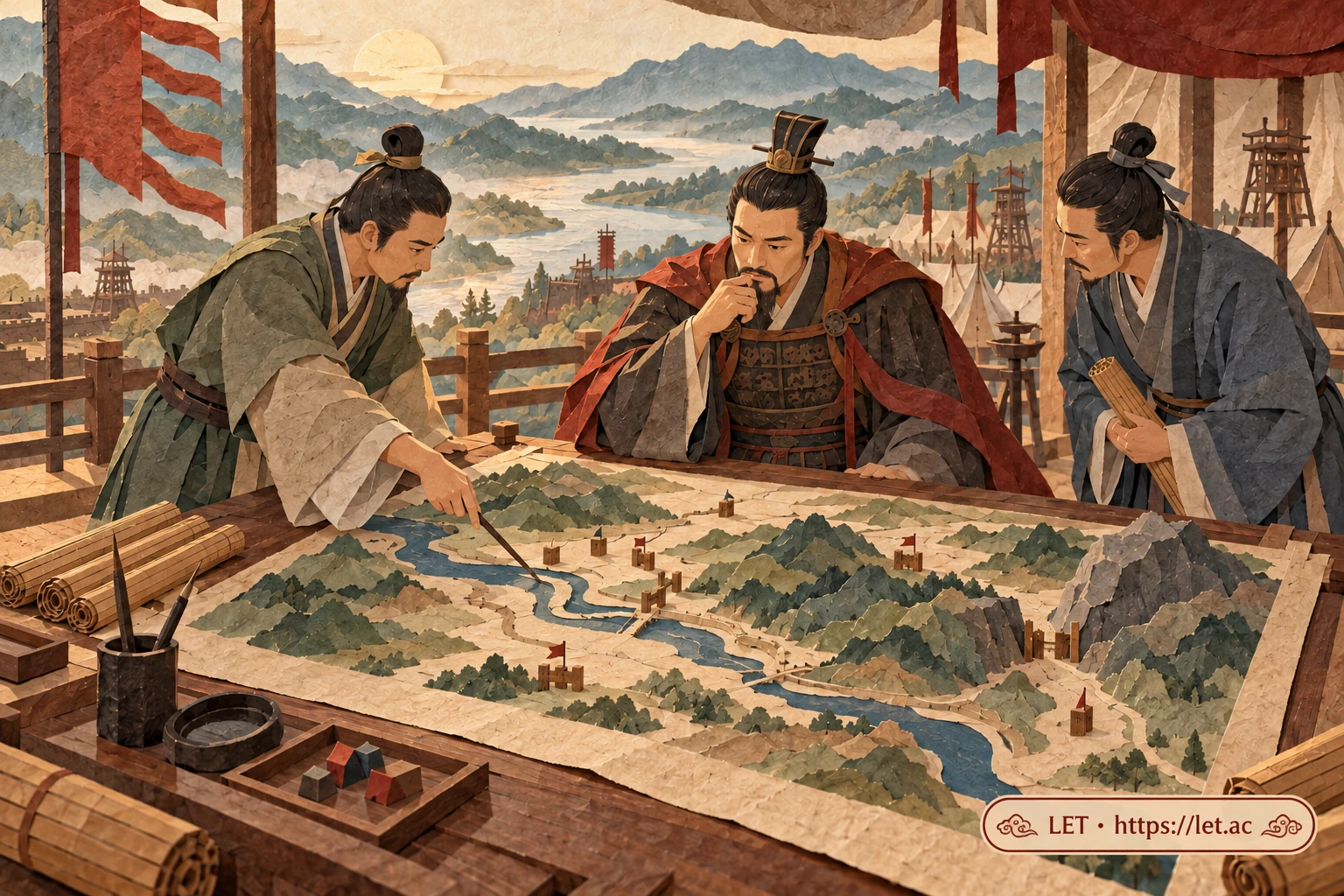
Sun Tzu opens with the stakes of war, then asks what makes a plan sound: shared purpose, conditions, leadership, organization, and honest comparison. Read the complete first chapter with an original English rendering, modern Chinese, and a practical example.
01 / A reading of the text, with context.
1. Begin with the stakes
Sun Tzu says: War is a matter of great consequence for a state. It is where life and death are decided, the path to survival or ruin. It demands close examination. Therefore, examine it through five factors, compare the two sides through seven assessments, and find out how things really stand. The five factors are shared purpose, Heaven, Earth, command, and organization.
02 / A reading of the text, with context.
2. Examine five foundations
Shared purpose means that the people and those above them are of one mind, so they can face death or life together without fearing danger. Heaven means light and darkness, cold and heat, and the timing of the seasons. Earth means height and depth, distance, difficult and easy ground, broad and narrow spaces, and positions that bring death or allow survival. Command means wisdom, trustworthiness, care for people, courage, and firmness. Organization means the structure of units, the allocation of responsibilities, and the management of supplies and resources. Every commander has heard of these five factors. Those who understand them win; those who do not, fail.
03 / A reading of the text, with context.
3. Ask seven comparative questions
So compare the two sides through seven assessments to uncover their true situation. Which ruler has the stronger shared purpose? Which commander is more capable? Which side has the advantage of weather and terrain? Which side carries out its rules and orders? Which force is stronger? Whose officers and soldiers are better trained? Whose rewards and punishments are clearer? Through these comparisons, I can judge victory and defeat.
04 / A reading of the text, with context.
4. Turn assessment into a flexible advantage
A commander who accepts my assessment and puts it into practice will win; keep him in command. A commander who rejects it will lose; remove him. Once the assessment of advantages has been accepted, build a favorable configuration to support action beyond the assessment itself. Such a configuration means adapting decisions to the advantages that circumstances offer.
05 / A reading of the text, with context.
5. Understand appearances and surprise
Warfare works through deception. When capable, appear incapable; when ready to act, appear inactive. When near, appear far away; when far away, appear near. Draw the enemy with an advantage, and seize the opportunity when they are disordered. If they are well prepared, prepare against them; if strong, avoid them. If they are prone to anger, unsettle them. Appear humble so that they become overconfident. If rested, wear them down; if united, draw them apart. Strike where they have made no preparation; appear where they do not expect you. These are ways armies win, but their application cannot be handed over as a finished prescription in advance.
06 / A reading of the text, with context.
6. Count real advantages before acting
Before battle, an assessment in the temple points to victory when it finds many advantages in one's favor; it points away from victory when it finds few. With many advantages, one wins; with few, one does not. How much less can be expected when no assessment is made at all? Looking at things this way, I can see the prospects of victory and defeat.
PAUSE & CONSIDER
Ideas to keep
- Start by identifying the consequences and the people who will bear them.
- Examine purpose, timing, terrain, leadership, and the system for getting things done.
- Compare actual capabilities and feasible options using the same questions and evidence.
- Make a plan that can respond when the conditions change.
- Count supported advantages, then revisit assumptions before committing to action.
AN ILLUSTRATIVE MODERN SCENARIO
A community book fair: an illustrative fictional scenario
A neighborhood reading group wants to hold an outdoor book exchange. Volunteers are excited, and the square looks large enough. Before announcing the event, the coordinator asks what failure would mean: soaked books, visitors waiting without directions, and volunteers left to solve problems alone. The group defines success as a welcoming exchange with dry books, clear routes, and manageable shifts.
The five factors become a practical checklist. Shared purpose: everyone agrees that access matters more than the number of tables. Timing: they check daylight and the weather conditions they will need to monitor. Ground: they walk the square, noting a narrow entrance and an accessible covered area nearby. Leadership: one person can make the call to move, with a deputy available. Organization: roles, a contact list, table locations, and a way to move the books are written down.
They compare two layouts against the same needs. An ambitious arrangement fills the square but blocks the entrance and requires more trained helpers than are available. A smaller arrangement keeps the route open and lets the existing team cover every station. A short rehearsal reveals that the planned book-transfer path crosses the visitor queue. They move the queue before event day. Their advantage comes from observing and correcting a real problem.
The plan includes a decision point: if conditions threaten to wet the books, the coordinator will move the exchange to the covered area and tell visitors and volunteers where to go. On the day, that change becomes necessary. The team uses the agreed roles and signs, checks that the accessible route stays open, and continues on a smaller scale. There is no opponent to mislead; clear communication helps everyone adapt.
孙子从战争的重大代价讲起,再以五事、七计审视条件:人心是否一致,时地是否有利,组织能否执行。本篇收录第一篇完整原文,配有英文译写、白话解释、逐段解读与现代案例。
01 / 把原文放回语境,慢慢读。
一、先问这件事有多重大
孙子说:战争是国家的大事,关系着人的生死,也关系着国家的存亡,必须认真考察。因此,要从五个方面分析,再用七项比较查明实际情况。五个方面是:道、天、地、将、法。
02 / 把原文放回语境,慢慢读。
二、用五事检查基础
“道”,是让民众与领导者意愿一致,能够共同面对生死,不畏惧危险。“天”,是昼夜、寒暑以及时令条件。“地”,是地势高低、路程远近、险阻或平易、宽阔或狭窄,以及所处位置是否有利于生存。“将”,是将领具备智慧、诚信、爱护人的心、勇气和严明的作风。“法”,是军队的编制、职责安排以及物资和资源的管理。这五个方面,将领都听说过;真正懂得它们的人能取胜,不懂得的人不能取胜。
03 / 把原文放回语境,慢慢读。
三、用七计比较实际能力
所以,要用七项比较来查清情况:哪一方的君主更能得到人心?哪一方的将领更有能力?哪一方占有天时地利?哪一方的法令落实得更好?哪一方的军队更强?哪一方的士卒训练更充分?哪一方的赏罚更明确?通过这些比较,就可以判断胜负的条件。
04 / 把原文放回语境,慢慢读。
四、让判断形成可调整的势
将领听从我的谋划并加以运用,就能取胜,应当留任;不听从而继续用兵,就会失败,应当撤换。听取了有利的分析之后,还要营造有利态势,帮助计划在实际行动中发挥作用。所谓“势”,就是依据有利条件,灵活决定应对办法。
05 / 把原文放回语境,慢慢读。
五、理解示形与出其不意
用兵包含欺骗对手的方法。因此,有能力时可以显示得没有能力,准备行动时可以显示得不行动;距离近时示远,距离远时示近。用利益引诱对方,在对方混乱时抓住机会;对方充实时做好准备,对方强大时避开它;利用对方的愤怒扰乱它,以谦卑姿态使它骄傲;对方安逸时使它疲劳,对方团结时设法离间。攻击对方没有防备之处,在它意料不到的时候或地方出现。这些是用兵取胜的方法,但具体怎样运用,不能事先作为固定办法传授完毕。
06 / 把原文放回语境,慢慢读。
六、行动前,数清真实的有利条件
还没有交战,在庙堂里比较筹划就判断能够取胜,是因为得到的有利条件多;判断不能取胜,是因为得到的有利条件少。有利条件多,胜算就大;有利条件少,胜算就小,更何况完全不做比较筹划呢?按照这些条件考察,胜负的趋势就显现出来了。
停下来,想一想
记住这些要点
- 先看后果,也看谁将承担后果。
- 把人心、时机、环境、领导与执行系统一起考察。
- 用同一组问题和证据,比较实际能力与可行方案。
- 让计划保留随条件变化而调整的空间。
- 数清有证据的有利条件,行动前再次复核假设。
现代情境示例 · 虚构案例
社区露天书市:虚构的说明案例
一个社区读书小组想办露天旧书交换。志愿者很热情,广场看起来也够大。宣布活动前,协调人先问失败会是什么样:书被雨淋湿,来访者找不到方向,志愿者各自应付突发问题。小组于是把目标说清楚:让大家方便交换,保证书本干燥、动线清楚、值班负担可承担。
五事变成具体检查。“道”:大家同意,方便参与比摆出多少张桌子更重要。“天”:查看日照时段,也确定之后需要关注的天气条件。“地”:实地走一遍广场,发现入口较窄,附近另有方便进出的有顶空间。“将”:指定能决定转场的人,并安排替补。“法”:写明分工、联系人、桌位和搬运书本的办法。
小组用同样的要求比较两种布局。大方案能摆满广场,却堵住入口,还需要更多熟悉流程的帮手;小方案保留通道,现有团队也能照顾各个岗位。一次简短演练又发现,搬书路线会穿过来访者排队的位置。他们提前移动排队区。这里的优势,来自发现并改正一个真实问题。
预案还设了一个决定节点:一旦天气有淋湿书本的风险,协调人就把交换活动移到有顶空间,并告知访客与志愿者位置。活动当天,确实需要转场。团队按既定分工设置指示,确认方便通行的路线保持畅通,再以较小规模继续活动。案例中的任务是共同完成书市,清楚沟通帮助大家一起应变。
Original Chinese & source
FULL ORIGINAL · TRADITIONAL CHINESE
始計第一
孫子曰:兵者,國之大事,死生之地,存亡之道,不可不察也。故經之以五事,校之以七計,而索其情:一曰道,二曰天,三曰地,四曰將,五曰法。
道者,令民與上同意,可與之死,可與之生,而不畏危也。天者,陰陽、寒暑、時制也。地者,高下、遠近、險易、廣狹、死生也。將者,智、信、仁、勇、嚴也。法者,曲制、官道、主用也。凡此五者,將莫不聞,知之者勝,不知者不勝。
故校之以七計而索其情,曰:主孰有道?將孰有能?天地孰得?法令孰行?兵眾孰強?士卒孰練?賞罰孰明?吾以此知勝負矣。
將聽吾計,用之必勝,留之;將不聽吾計,用之必敗,去之。計利以聽,乃為之勢,以佐其外。勢者,因利而制權也。
兵者,詭道也。故能而示之不能,用而示之不用,近而示之遠,遠而示之近。利而誘之,亂而取之,實而備之,強而避之,怒而撓之,卑而驕之,佚而勞之,親而離之。攻其無備,出其不意。此兵家之勝,不可先傳也。
夫未戰而廟算勝者,得算多也;未戰而廟算不勝者,得算少也。多算勝,少算不勝,而況於無算乎?吾以此觀之,勝負見矣。
The complete traditional Chinese text follows Wikisource’s online transcription of 始計第一, checked on October 12, 2026. The six reading sections are LET’s editorial divisions; the source has four paragraphs. This is a reading edition, not a comparison of manuscript variants.
English rendering, modern Chinese paraphrase, and commentary were written independently by LET with AI assistance from the Chinese text. They are editorial interpretations, separate from the quoted original. The book-fair scenario is fictional and is not attributed to Sun Tzu.