THE ART OF WAR CHAPTER 11
The Nine Situations
九地篇
A force's situation changes with its distance, connections, and remaining choices.
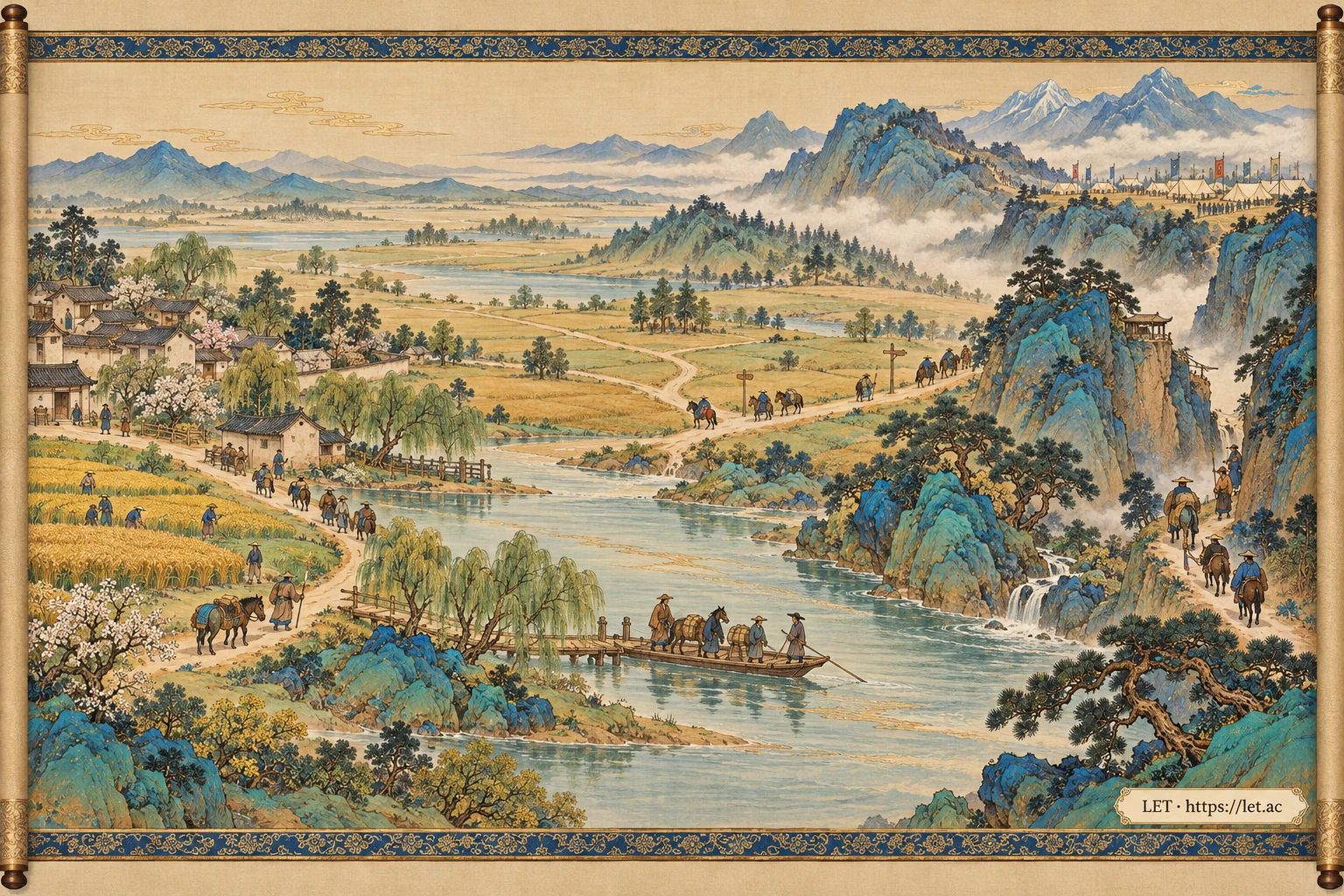
Sun Tzu's longest chapter classifies nine military situations, then examines supply, mutual support, command, secrecy, and the coercive use of danger. Read the complete eleventh chapter with independent English, modern Chinese, bilingual commentary, and a fictional touring exhibition that responds to changing conditions through open information and agreed choices.
01 / A reading of the text, with context.
1. Read nine situations, rather than nine landforms
Sun Tzu says: In warfare there is dispersive ground, light ground, contested ground, open ground, crossroads ground, deep ground, difficult ground, enclosed ground, and desperate ground. When rulers fight within their own territory, that is dispersive ground. Entering another's territory without going far is light ground. Ground whose possession benefits either side is contested ground. Where we can go and they can come is open ground. Where three rulers' territories meet, and arriving first can gain the support of other powers, is crossroads ground. Going deep into another's territory, leaving many cities and settlements behind, is deep ground. Mountains, forests, obstacles, marshes, and all routes difficult to travel are difficult ground. Where the entrance is narrow, the return route circuitous, and a few of the enemy can attack many of us is enclosed ground. Where fighting swiftly means survival and failing to do so means destruction is desperate ground.
02 / A reading of the text, with context.
2. Match the response to the situation
Thus on dispersive ground, do not fight; on light ground, do not stop; on contested ground, do not attack; on open ground, do not let the army's parts become disconnected; on crossroads ground, form alliances; on deep ground, seize provisions; on difficult ground, keep moving; on enclosed ground, devise a plan; on desperate ground, fight.
03 / A reading of the text, with context.
3. Keep the proposal for disrupting an enemy explicit
Those called skilled users of armies in ancient times could prevent the enemy's front and rear from reaching one another, large and small units from relying on one another, high and low ranks from rescuing one another, and superiors and subordinates from drawing together. Separated soldiers could not assemble; assembled troops could not act in order. They moved when action accorded with advantage and stopped when it did not.
04 / A reading of the text, with context.
4. Understand speed through the military objective
One may ask: ‘If a numerous and orderly enemy is approaching, how should they be met?’ The answer is: ‘First seize what they value, and they will follow your direction.’ Thus the conduct of war prizes speed: take advantage of what the enemy cannot reach in time, use a route they do not expect, and attack what they have not guarded against.
05 / A reading of the text, with context.
5. Follow depth with supply and care for the force
For an invading force, going deep makes its purpose concentrated, so the defending side cannot defeat it. Seize provisions from rich countryside so the whole army has enough to eat. Care for the troops attentively without exhausting them; gather their spirit and accumulate their strength. Move the army and devise plans in ways that cannot be measured by the enemy.
06 / A reading of the text, with context.
6. Read the claim about removing every alternative
Put them where there is nowhere to go, and they will not flee even in the face of death. With a resolve to die, how could they fail to attain their aim? Officers and men give their utmost. Deeply trapped soldiers do not fear; with nowhere to go they stand firm; deep penetration binds them together; having no alternative, they fight. Thus the troops become alert without additional ordering, give their effort without its being demanded, draw close without a compact, and trust without another command.
07 / A reading of the text, with context.
7. Keep the sacrifice and distress visible
Ban talk of omens and remove doubts, so that even facing death the troops turn nowhere else. Our soldiers hold back no possessions, not because they dislike wealth; they hold back no part of their lives, not because they dislike longevity. On the day the order is issued, seated soldiers wet their collars with tears, and those lying down have tears running across their cheeks. Put them where they have nowhere to go, and they show the courage of Zhuan Zhu and Cao Gui.
08 / A reading of the text, with context.
8. Examine mutual support and the pressure behind it
Thus a skilled user of armies is like Shuairan, the snake of Mount Chang. Strike its head and the tail comes; strike its tail and the head comes; strike its middle and both head and tail come. One may ask: ‘Can troops be made like Shuairan?’ The answer is: ‘Yes. People of Wu and Yue dislike one another, yet when crossing in the same boat and meeting a storm, they help one another like the left and right hands.’ Therefore, binding horses and burying wheels are not enough to rely on. Making courage equal as though in one person is the work of military administration; making both the strong and the weak useful is the effect of the ground. Thus a skilled commander leads the force as though taking one person's hand, because the troops have no alternative.
09 / A reading of the text, with context.
9. Read the commander's concealment from the troops plainly
The commander's work is to be calm and inscrutable, upright and orderly. The commander can mislead the soldiers' ears and eyes, leaving them without knowledge; change undertakings and revise plans so people cannot recognize them; change encampments and make routes circuitous so people cannot work out the intention.
10 / A reading of the text, with context.
10. See the removal of return in the ladder, boats, and pots
When the commander commits the troops to the appointed undertaking, it is like taking them up high and removing the ladder. The commander leads them deep into other rulers' territory and releases the mechanism, burns boats and breaks cooking pots, as though driving a flock of sheep. They are driven forward and back without knowing where they are going. Gathering the whole army and casting it into danger is what the text calls the commander's work. Changes among the nine situations, the advantages of contraction and extension, and the workings of human responses must all be examined.
11 / A reading of the text, with context.
11. Revisit depth, isolation, and the remaining routes
For an invading force, deep penetration concentrates purpose, while shallow penetration leaves it dispersed. Leaving one's state and crossing a border to campaign is isolated ground. Ground reaching in four directions is crossroads ground; going deep is deep ground; entering only a little is light ground; having a barrier behind and a narrow passage ahead is enclosed ground; having nowhere to go is desperate ground.
12 / A reading of the text, with context.
12. Distinguish support measures from coercive measures
Thus on dispersive ground I would unite their purpose; on light ground keep the units connected; on contested ground hurry the rear elements forward; on open ground guard carefully; on crossroads ground strengthen alliances; on deep ground keep food coming; on difficult ground advance along the route; on enclosed ground close the remaining opening; on desperate ground show the troops that they cannot expect to stay alive. For troops, enclosure brings resistance, having no alternative brings fighting, and being driven deep into peril brings obedience.
13 / A reading of the text, with context.
13. Read local knowledge and hegemonic power with their ambiguities
Thus those who do not know other rulers' plans cannot form alliances in advance; those who do not know the mountains, forests, obstacles, and marshes cannot march; those who do not use local guides cannot obtain the ground's advantages. If even one of these ‘four and five’ matters is unknown, this is not an army fit for a king or hegemon. When such an army attacks a great state, that state's forces cannot assemble; when its pressure bears upon the enemy, the enemy's alliances cannot join together. Thus it does not compete for every alliance in the realm or sustain the other powers of the realm. It extends its own purpose and brings pressure upon the enemy, so the enemy's cities can be taken and its state overthrown.
15 / A reading of the text, with context.
15. Read the closing sequence of secrecy and sudden action
Thus when the orders for the undertaking are put into effect, close the passes, break the travel tallies, and allow no passage to envoys. Deliberate rigorously in the council hall to settle the undertaking. When the enemy opens a gap, enter quickly; get ahead of them at what they value; covertly fix the encounter; keep to disciplined rules while following the enemy's changes, so as to decide the battle. Thus at first be like a maiden, so the enemy opens their door; later be like a hare breaking free, so the enemy cannot resist in time.
PAUSE & CONSIDER
Ideas to keep
- Examine distance, access, support, and remaining choices together.
- Adapt supply and communication to the actual stage of an undertaking.
- Build mutual help through shared knowledge and agreed responsibilities.
- Distinguish analysis of a situation from coercion that removes people's choices.
- Keep burdens, reduction, return, and withdrawal visible in voluntary cooperation.
AN ILLUSTRATIVE MODERN SCENARIO
A touring community exhibition: an illustrative fictional scenario
A small team prepares a traveling exhibition of neighborhood photographs for several community venues. Near its home base, volunteers can return after short shifts and spare materials can arrive quickly. The coordinator does not assume that closeness makes everyone available. Participants agree their hours, packing duties, and handover points. The shared schedule records who is at the base, who travels, and how a venue can reach either group.
For a farther stop, repair materials and return transport take longer to arrange. The team discusses those differences openly before anyone commits to the trip. It confirms storage, transport, meals, rest, and locally agreed services with the host. One volunteer chooses only the nearby stops; another agrees to the farther journey with a planned return. Local collaborators explain the delivery entrance, room layout, and working hours. The team treats that knowledge as part of the plan, not as an obstacle to its own independence.
At another venue, a narrow delivery route and a delayed shipment change what the group can install. The coordinator shares the new information with the host and all traveling participants. They compare waiting for the full display, using a smaller selection already present, and postponing the stop. A smaller display can still serve the agreed purpose without asking the host for unapproved space or requiring the volunteers to extend their trip. They confirm the revised arrangement together and publish an accurate notice for visitors.
Packing and installation teams practice helping one another, with clear contacts when a person or item is missing. A confirmed return journey remains available, and a participant can step back from the changed task. The team does not cancel transport, hide the delay, or manufacture a last-chance crisis to bind people together. When the next distant stop lacks the support they had agreed was necessary, they postpone it and bring the materials home. Some of the intended tour remains unfinished, and that limit is recorded honestly.
The review compares how each stop's distance, transport, local support, and available choices changed the organization. A nearby stop needed flexible handovers; a distant one needed more confirmed supplies and return arrangements; a constrained venue called for a smaller format. The record becomes useful preparation for a later tour. Its strength lies in examining the situation with the people affected, while preserving their understanding and choices. No successful fictional stop proves that trapping a team would have made it stronger.
本篇以九地分析军队的深入程度、支援与进退条件,随后讨论补给、相互接应、指挥、隐瞒及强制置险。本页收录第十一篇完整原文,配有独立英文译写、白话解释、双语解读,以及通过公开信息与商定选择来应变的虚构巡回展览案例。
01 / 把原文放回语境,慢慢读。
一、九地是九种处境,不只是九种地貌
孙子说:用兵有散地、轻地、争地、交地、衢地、重地、圮地、围地、死地。诸侯在自己的境内作战,是散地;进入别人境内还不深,是轻地;我方得到有利、敌方得到也有利,是争地;我方可以前往、敌方也可以来到,是交地;三方诸侯的土地相接,先到能够取得其他势力支持,是衢地;进入别人境内很深,身后经过许多城邑,是重地;山林、险阻、沼泽等难行地段,是圮地;进入道路狭窄,返回道路迂远,对方少数人就能打击我方多数人,是围地;迅速力战才可能生存,不迅速力战就会覆亡,是死地。
02 / 把原文放回语境,慢慢读。
二、依处境选择相应行动
因此,在散地不轻易交战,在轻地不停留,在争地不强攻敌方已据之处,在交地不使队伍断开,在衢地联结盟友,在重地掠取补给,在圮地继续行进,在围地设法谋划,在死地奋战。
03 / 把原文放回语境,慢慢读。
三、明确保留打乱敌方协同的原义
古代所谓善于用兵的人,能够使敌方前后不能接应,大小部队不能相互依靠,高低等级不能相互救援,上下不能收合;分散的士卒不能集合,集合的军队也不能整齐行动。有利才行动,不符合有利条件就停止。
04 / 把原文放回语境,慢慢读。
四、结合军事目的理解速
可以问:敌人数量众多、队伍整齐,正要来到,应怎样应对?回答是:先夺取它所重视、所依赖的东西,它就不得不随你的安排应对。因此,用兵重视迅速,利用敌人来不及应对之处,走它没有预料的道路,攻击它没有戒备的地方。
05 / 把原文放回语境,慢慢读。
五、深入之后,更要看补给与休养
作为进入别人境内的军队,深入会使意志集中,使守方不能战胜它。从富饶田野掠取补给,让全军食粮充足。细心养护士卒,不使他们劳顿,凝聚士气,积蓄力量,调动军队、谋划行动,让敌人难以测知。
06 / 把原文放回语境,慢慢读。
六、直面剥夺退路来求力战的主张
把士卒放到无处可去的地方,他们即使面临死亡也不会败逃。决意死战,还有什么目的不能达到?士人与士卒便尽力行动。深陷险境就不再畏惧,无处可去就坚定,深入敌境便如被拘束,迫不得已就奋战。因此,部队不用另行整治也会戒备,不用另求也能取得其力量,不用约束也会相亲,不用再下令也会信从。
07 / 把原文放回语境,慢慢读。
七、不要抹去牺牲与眼泪
禁止谈论祸福征兆,去除疑虑,让士卒直至面临死亡也不转向别处。他们不留下财物,不是因为厌恶钱财;他们不保留性命,不是因为厌恶长寿。命令发布那天,坐着的士卒泪湿衣襟,躺着的士卒眼泪流过面颊。把他们置于无处可去之地,就会有专诸、曹刿那样的勇气。
08 / 把原文放回语境,慢慢读。
八、既看相互救应,也看背后的压力
所以,善于用兵的人像率然。率然是常山的一种蛇:打它的头,尾巴就来接应;打它的尾,头就来接应;打中段,头尾一起来接应。可以问:军队也能像率然吗?回答是:可以。吴人和越人互相厌恶,同乘一船渡水遇上风浪时,却会像左右手那样相互救助。因此,仅把马束住、车轮埋住,还不足以依靠。使众人勇气齐一,靠军政;使强弱之人都能发挥作用,靠地势。善于用兵的人领着军队,如同牵一人的手,因为他们已不得不如此。
09 / 把原文放回语境,慢慢读。
九、直读对士卒隐瞒安排的指挥主张
将领办事要沉静深隐、公正有序。能够蒙蔽士卒的耳目,使他们不知道安排;变换行动,改变谋划,使人不能识别;更换驻地,绕远道路,使人不能推测意图。
10 / 把原文放回语境,慢慢读。
十、看清去梯、焚舟与破釜中的断退路
将领把士卒带到约定行动的关头,如同让他们登高后撤去梯子;率他们深入诸侯境内,发动既定行动,烧船、打破炊锅,如同驱赶羊群。驱着往,驱着来,他们不知道将去何处。聚集全军,把它投入危险,原文称这为将领的事务。九地的变化、收缩与展开的利害,以及人的反应规律,都必须认真考察。
11 / 把原文放回语境,慢慢读。
十一、再看深浅、隔绝与可用道路
作为进入别人境内的军队,深入会使意志集中,进入较浅则容易分散。离开本国、越境作战,是隔绝的处境;四方通达,是衢地;进入很深,是重地;进入较浅,是轻地;背后有险固、前面有隘口,是围地;无处可去,是死地。
12 / 把原文放回语境,慢慢读。
十二、区分支撑措施与强迫措施
因此,在散地,我会统一意志;在轻地,使部队相接;在争地,催后队赶上;在交地,谨慎守备;在衢地,巩固联结;在重地,使食粮接续;在圮地,推动队伍前行;在围地,堵住剩余出口;在死地,向士卒显示不能活下来。所以,军队被围就会抵御,迫不得已就会战斗,深陷危险便会服从。
13 / 把原文放回语境,慢慢读。
十三、连同异说读当地知识与霸王兵
所以,不知道诸侯的谋划,就不能预先结交;不懂山林、险阻、沼泽的形态,就不能行军;不用当地向导,就不能取得地利。所谓“四五”这些要务,有一项不明白,就不是足以成就王霸之业的军队。这样的军队攻击大国,使敌方兵众不能集合;兵威加于敌人,使敌方交援不能合成。因此,它不争取天下所有交援,也不培植天下其他势力的权力,伸展本方意图,以兵威施压,使敌方城池可以被攻取,国家可以被摧毁。
15 / 把原文放回语境,慢慢读。
十五、读完保密、法度与骤然行动的收束
因此,行动政令实施之日,封闭关口、折毁通行符信,不让使者往来;在议事庙堂上严谨筹划,处理这件事。敌人出现空隙,就要迅速进入;抢先取得它重视之处,隐微安排交会时机,遵循法度而随敌变化,以决定战事。所以,开始如处女般安静示弱,使敌人打开门户;随后如脱逃的兔子般迅疾,使敌人来不及抵拒。
停下来,想一想
记住这些要点
- 把距离、通路、支援与剩余选择一起检查。
- 让补给与沟通随事务所处阶段而调整。
- 通过共享知识与商定职责,建立相互接应。
- 区分处境分析与剥夺人的选择来强迫行动。
- 志愿合作中,公开负担,也保留缩减、返程与退出。
现代情境示例 · 虚构案例
跨地区巡回展览:虚构的说明案例
一个小团队准备把社区老照片带到几个地区的公共场所巡展。靠近本部时,志愿者可以短时值班后返回,备用材料也容易送到。协调人不把距离近当成人随时可用,而是与大家商定时间、打包职责与交接节点。共享日程写明谁留在本部,谁随行,接待场所怎样联系两组人。
较远的一站,维修材料和返程交通都需要更久安排。任何人答应出发前,团队先公开讨论这些差别,与接待方确认仓储、运输、用餐、休息和经同意取得的本地服务。一位志愿者只选择附近场次,另一位在返程安排明确后接受远行。当地伙伴介绍装卸入口、房间布局与工作时段,团队把这些知识纳入计划,不把它看作本方自主的障碍。
另一个场所的送货通路较窄,一批展品又延迟,能够布置的内容发生变化。协调人向接待方与全体随行者共享新信息,比较等待完整展览、先展已到的小部分,以及延期这一站。较小展示仍能达到商定目的,也不要求接待方提供未同意的空间,或逼志愿者延长旅程。大家共同确认新安排,并向观众发布准确说明。
打包与布展两组练习相互替补,人员或物品缺少时都有清楚的联系人。已经确认的返程仍然保留,参与者也能不接受改变后的任务。团队不撤掉交通、不隐瞒延迟,也不制造“最后一搏”的危机来捆住人。下一站较远,缺少事先商定的必要支持,他们便延期,把材料带回本部。原定巡程有一部分尚未完成,这份局限如实记下。
复盘比较各站的距离、运输、当地支持与可用选择,怎样改变组织方式:近处需要灵活交接,远处需要更充分确认补给与返程,受限场所则适合缩小形式。这份记录帮助下一次巡展准备。有用之处,是与受影响的人一起检查处境,并保留他们的理解和选择;虚构场次的完成,不能拿来证明把团队困住反而会更强。
Original Chinese & source
FULL ORIGINAL · TRADITIONAL CHINESE
九地第十一
孫子曰:凡用兵之法,有散地,有輕地,有爭地,有交地,有衢地,有重地,有圮地,有圍地,有死地。諸侯自戰其地者,為散地;入人之地而不深者,為輕地;我得則利,彼得亦利者,為爭地;我可以往,彼可以來者,為交地;諸侯之地三屬,先至而得天下之衆者,為衢地;入人之地深,背城邑多者,為重地;山林、險阻、沮澤,凡難行之道者,為圮地;所由入者隘,所從歸者迂,彼寡可以擊吾之衆者,為圍地;疾戰則存,不疾戰則亡者,為死地。
是故散地則無戰,輕地則無止,爭地則無攻,交地則無絕,衢地則合交,重地則掠,圮地則行,圍地則謀,死地則戰。
所謂古之善用兵者,能使敵人前後不相及,衆寡不相恃,貴賤不相救,上下不相收,卒離而不集,兵合而不齊。合於利而動,不合於利而止。
敢問︰「敵衆整而將來,待之若何?」曰:「先奪其所愛,則聽矣。」故兵之情主速,乘人之不及,由不虞之道,攻其所不戒也。
凡為客之道,深入則專,主人不克。掠于饒野,三軍足食。謹養而勿勞,併氣積力,運兵計謀,為不可測。
投之無所往,死且不北。死焉不得,士人盡力。兵士甚陷則不懼,無所往則固,深入則拘,不得已則鬥。是故其兵不修而戒,不求而得,不約而親,不令而信。
禁祥去疑,至死無所之。吾士無餘財,非惡貨也;無餘命,非惡壽也。令發之日,士卒坐者涕沾襟,偃臥者淚交頤。投之無所往者,則諸、劌之勇也。
故善用兵者,譬如率然。率然者,常山之蛇也。擊其首則尾至,擊其尾則首至,擊其中則首尾俱至。敢問︰「兵可使如率然乎?」曰︰「可。夫吳人與越人相惡也,當其同舟而濟。遇風,其相救也,如左右手。」是故方馬埋輪,未足恃也;齊勇如一,政之道也;剛柔皆得,地之理也。故善用兵者,攜手若使一人,不得已也。
將軍之事,靜以幽,正以治。能愚士卒之耳目,使之無知;易其事,革其謀,使人無識;易其居,迂其途,使人不得慮。
帥與之期,如登高而去其梯;帥與之深入諸侯之地,而發其機,焚舟破釜,若驅群羊。驅而往,驅而來,莫知所之。聚三軍之衆,投之於險,此謂將軍之事也。九地之變,屈伸之利,人情之理,不可不察也。
凡為客之道,深則專,淺則散。去國越境而師者,絕地也;四達者,衢地也;入深者,重地也;入淺者,輕地也;背固前隘者,圍地也;無所往者,死地也。
是故散地,吾將一其志;輕地,吾將使之屬;爭地,吾將趨其後;交地,吾將謹其守;衢地,吾將固其結;重地,吾將繼其食;圮地,吾將進其途;圍地,吾將塞其闕;死地,吾將示之以不活。故兵之情:圍則禦,不得已則鬥,過則從。
是故不知諸侯之謀者,不能豫交;不知山林、險阻、沮澤之形者,不能行軍;不用鄉導者,不能得地利。四五者,不知一,非霸王之兵也。夫霸王之兵,伐大國,則其衆不得聚;威加於敵,則其交不得合。是故不爭天下之交,不養天下之權,信己之私,威加於敵,則其城可拔,其國可隳。
施無法之賞,懸無政之令。犯三軍之衆,若使一人。犯之以事,勿告以言;犯之以利,勿告以害。投之亡地然後存,陷之死地然後生。夫衆陷於害,然後能為勝敗。故為兵之事,在於佯順敵之意,併敵一向,千里殺將,是謂巧能成事者也。
是故政舉之日,夷關折符,無通其使;厲於廊廟之上,以誅其事。敵人開闔,必亟入之,先其所愛,微與之期,踐墨隨敵,以決戰事。是故始如處女,敵人開戶;後如脫兔,敵不及拒。
The complete traditional Chinese text follows Wikisource’s online transcription of 九地第十一, revision 7906064, checked on October 12, 2026. LET divides the source's eight paragraphs into fifteen reading sections without altering their wording or punctuation. Traditional commentaries, revision 2136090, informed difficult terms and alternative readings. This is a reading edition, not a comparison of manuscript variants.
English rendering, modern Chinese paraphrase, and commentary were written independently by LET with AI assistance from the Chinese text. They are editorial interpretations, separate from the quoted original. The touring-exhibition scenario is fictional and is not attributed to Sun Tzu. Its cooperative applications are LET’s analogies, distinct from the original military proposals and command relationships.