THE ART OF WAR CHAPTER 10
Terrain
地形篇
Read the ground together with the force that must act on it.
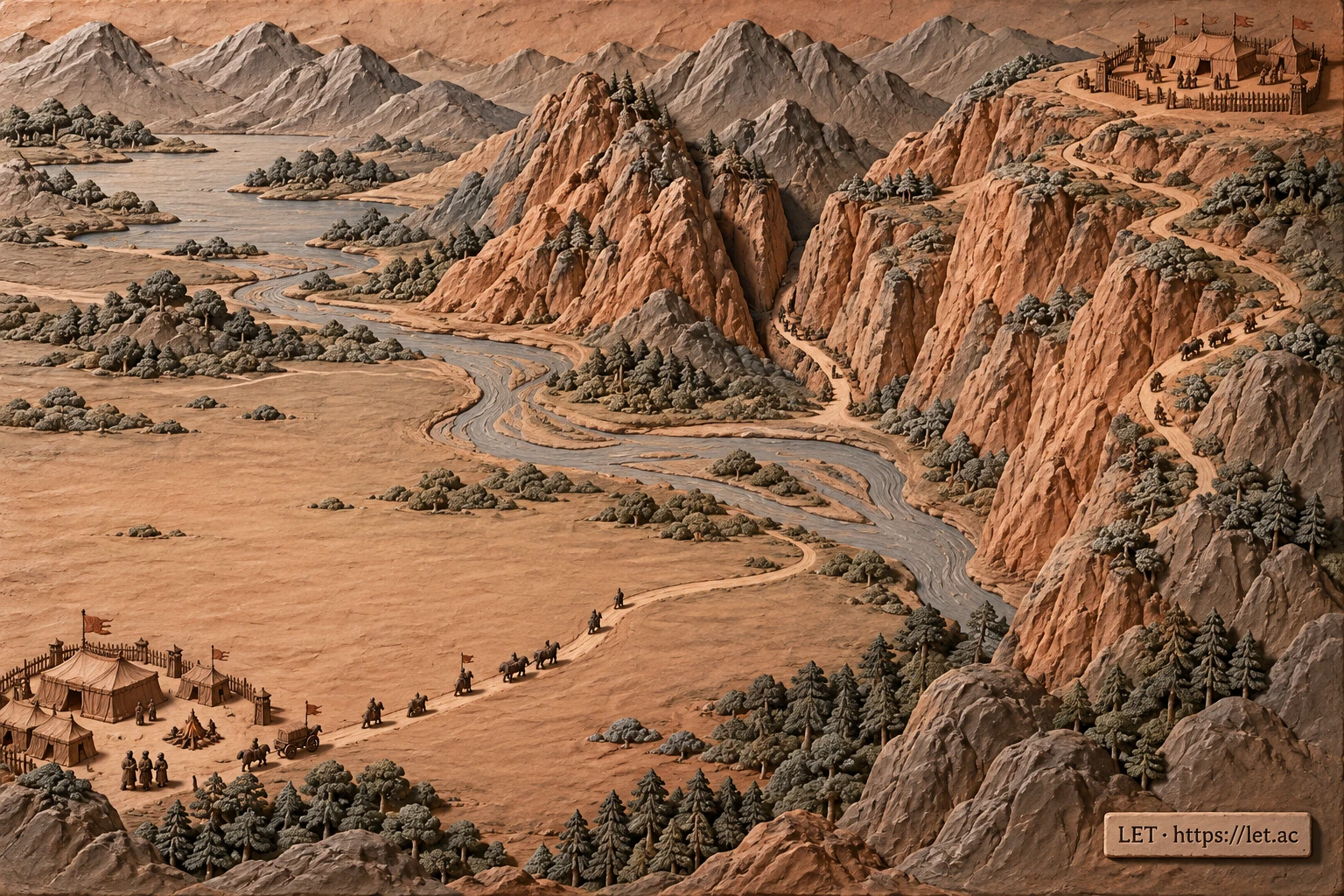
Sun Tzu distinguishes six kinds of terrain and six failures within an army, then joins command responsibility, care, discipline, and knowledge of the conditions. Read the complete tenth chapter with independent English, modern Chinese, bilingual commentary, and a fictional theatre troupe comparing borrowed venues with its actual preparations.
01 / A reading of the text, with context.
1. Consider the approach and the return
Sun Tzu says: Terrain includes the accessible, the entangling, the holding, the narrow, the steep, and the distant. Ground where we can go forward and the enemy can come toward us is called accessible. On accessible ground, occupy a high, sunny position first and secure the supply route; this gives an advantage in battle. Ground that can be entered but is difficult to return from is called entangling. On entangling ground, if the enemy is unprepared, go out and defeat them. If they are prepared and the advance fails, returning is difficult, and the position is unfavorable.
02 / A reading of the text, with context.
2. Read the restrictions at a stand-off or a bottleneck
Ground where it is unfavorable for us to go out and unfavorable for the enemy to go out is called holding ground. On holding ground, even if the enemy offers an advantage, do not go out. Withdraw and draw them after you; strike when they are halfway out, and the advantage is yours. On narrow ground, if we occupy it first, fully cover the passage and wait for the enemy. If the enemy occupies it first and fully covers it, do not follow them in; if they have not fully covered it, follow them in.
03 / A reading of the text, with context.
3. Include height, distance, and the effort of reaching the ground
On steep ground, if we occupy it first, take a high, sunny position and wait for the enemy. If the enemy occupies it first, withdraw and do not follow them. On distant ground, when the forces are evenly matched, it is difficult to provoke a battle, and fighting is unfavorable. These six are the principles of terrain. Examining them is a commander's most serious responsibility and must never be neglected.
04 / A reading of the text, with context.
4. Examine failures created within the force
An army can suffer flight, slack discipline, being overwhelmed, collapse, disorder, or rout. These six are not disasters sent by Heaven; they are the commander's faults. When conditions are otherwise evenly matched, sending one against ten is called flight. When the soldiers are strong and the officers weak, this is called slack discipline. When the officers are strong and the soldiers weak, this is called being overwhelmed.
05 / A reading of the text, with context.
5. Give the force clear direction and an informed commitment
When senior officers are angry and refuse obedience, meet the enemy and fight on their own out of resentment, while the commander does not understand their capabilities, this is called collapse. When the commander is weak and lacks strictness, instruction is unclear, officers and soldiers have no settled order, and troops are arrayed haphazardly, this is called disorder. When the commander cannot assess the enemy, engages many with few and the strong with the weak, and has no selected vanguard, this is called rout. These six are paths to defeat. Examining them is a commander's most serious responsibility and must never be neglected.
06 / A reading of the text, with context.
6. Decide by the task's conditions and accept responsibility
Terrain is an aid to an army. Assessing the enemy to establish victory and reckoning difficult ground, narrow places, distance, and proximity are the way of a superior commander. Those who understand these things and fight will win; those who do not understand them and fight will lose. If the conditions of battle make victory certain, one may fight even when the ruler says not to. If those conditions do not support victory, one may decline to fight even when the ruler orders battle. A commander who advances without seeking fame, retreats without shrinking from punishment, protects the people, and acts in a way that accords with the ruler's interests is a treasure to the state.
07 / A reading of the text, with context.
7. Read care together with direction and discipline
Regard soldiers as infants, and you can go with them into deep ravines. Regard them as beloved sons, and you can die together with them. But if you are generous and cannot direct them, affectionate and cannot make orders obeyed, and unable to put disorder right, they are like spoiled children and cannot be used in battle.
08 / A reading of the text, with context.
8. Complete the comparison: the sides, the ground, and the timing
To know that our soldiers can attack, but not know that the enemy cannot be successfully attacked, is only half of victory. To know that the enemy can be attacked, but not know that our soldiers cannot undertake it, is only half of victory. To know that the enemy can be attacked and our soldiers can attack, but not know that the terrain does not permit battle, is only half of victory. Thus those who understand warfare move without going astray and undertake action without becoming trapped. Hence the saying: know the enemy and know yourself, and victory is not imperiled; know the conditions of Heaven and the ground, and victory can be complete.
PAUSE & CONSIDER
Ideas to keep
- Check the approach, movement within the site, and return before committing people and equipment.
- Compare a place's demands with the team's actual preparation, resources, and available time.
- When work fails, examine assessment, instruction, and coordination before attaching labels to people.
- Provide care and workable support alongside clear, agreed responsibilities.
- Choose whether and how to proceed from the evidence, and keep the decision's consequences visible.
AN ILLUSTRATIVE MODERN SCENARIO
A community theatre troupe: an illustrative fictional scenario
A community theatre troupe is choosing between two borrowed venues. The central hall has a generous stage but a narrow entrance for scenery. A smaller room has a broad ground-level door, with a longer route from the troupe's storage space. Volunteers first compare the actual job: transport the agreed props, prepare the performance, keep audience movement clear, and return the borrowed room and equipment afterward. They visit both sites with the hosts rather than deciding from photographs of the stages.
The team measures each doorway and the widest prop, checks turning space, and walks the path from unloading to storage and stage. In the larger hall, a rigid backdrop cannot make the turn after entering. In the smaller room, its assembled width would leave too little room for audience movement. With the hosts' agreement, the troupe chooses a lighter set made from smaller pieces and tries a sample load-in. It also checks the return route and the time available for clearing the room after the performance.
The coordinator compares the revised demands with the team. One person maintains the prop register, another gives stage cues, and a named backup can help when a role needs cover. New volunteers receive a short rehearsal and written instructions. Setup and audience admission have separate agreed periods at the shared doorway. People discuss how long they can work and which tasks they are comfortable taking on. Breaks, help, and a way to raise an unclear instruction are part of the arrangement, alongside the responsibilities everyone has accepted.
Some members had hoped to use the larger backdrop because it looks impressive. The coordinator shares the measurements and trial results, explains the cost of forcing it through, and accepts disappointment about the reduced set. The troupe and host agree on the smaller plan. On the day, an unexpected delivery uses part of the loading area. Before moving the props, they confirm a revised route and tell the volunteers which path is now available. The prepared plan gives them a basis for discussing the change, rather than an instruction to proceed regardless.
The performance takes place with the smaller set, and the prop register helps the team check the return. A delayed cue still occurs, and the debrief finds that the backup's handover needs clearer wording. The troupe records both the venue measurements and that instruction gap for its next production. The room and team were considered together; neither the attractive stage nor the volunteers' enthusiasm would have been enough on its own. The fictional outcome leaves continuing work for the next rehearsal.
孙子区分通、挂、支、隘、险、远六种地形,再列出六种军队败因,讨论将领责任、照顾与纪律,以及敌我、天时和地形的完整考察。本篇收录第十篇完整原文,配有独立英文译写、白话解释、双语解读和一个比较借用场地与团队准备的虚构社区剧团案例。
01 / 把原文放回语境,慢慢读。
一、既看能否前往,也看能否返回
孙子说:地形有通、挂、支、隘、险、远六类。本方可以前往,对方也可以来到,叫“通”。在通形上,应先占高处向阳的位置,使粮道便利而有保障,这样作战有利。可以前往,却难以返回,叫“挂”。在挂形上,敌人没有准备,可以出击取胜;敌人若有准备,出击又未能取胜,就难以返回,因而不利。
02 / 把原文放回语境,慢慢读。
二、看相持之地与狭口的行动限制
本方出动不利,对方出动也不利,叫“支”。在支形上,即使敌人用好处引诱,也不要出动;可以引军离去,使敌人跟出,等它出来一半时攻击,才有利。狭隘地形,若本方先占据,就要充分占住狭口等待敌人;若敌人先占据,而且布置充实,就不要跟进去;没有充分占住,则可以跟进。
03 / 把原文放回语境,慢慢读。
三、把高低、远近与到达的代价一起考察
险阻地形,若本方先占据,就要占高处向阳的位置等待敌人;敌人若已先占据,应引军离开,不要跟去。在相距遥远的地形上,如果双方条件相当,就难以邀战,交战也不利。这六类是利用地形的道理,属于将领极重要的责任,不能不认真考察。
04 / 把原文放回语境,慢慢读。
四、检查队伍内部造成的败因
军队会发生走、弛、陷、崩、乱、北六种失败。这六种并不是天降灾祸,而是将领的过失。其他条件相当,却用一份兵力攻击十份,叫“走”,即奔逃;士卒强而军吏弱,叫“弛”,即统率纪律松弛;军吏强而士卒弱,叫“陷”,即陷入败境;
05 / 把原文放回语境,慢慢读。
五、让队伍有清楚的统属与经过判断的行动
高级军吏愤怒而不服从,遇敌时因怨愤自行交战,将领又不了解他们的能力,叫“崩”,即全军崩溃。将领软弱而不严格,教导不清楚,军吏与士卒没有稳定规矩,队列纵横杂乱,叫“乱”。将领不能估量敌人,用少数迎战多数,用弱者攻击强者,又没有选拔精锐作为前锋,叫“北”,即败逃。这六种是导致失败的道路,属于将领极重要的责任,不能不认真考察。
06 / 把原文放回语境,慢慢读。
六、依据行动条件决定,也承担决定的责任
地形是军队的辅助。估量敌情以形成取胜条件,计算险阻、狭隘、远近,是高明将领应做的事。懂得这些而作战,必能取胜;不懂得这些而作战,必会失败。因此,作战条件能够确保取胜,君主虽说不要打,也可以决定交战;作战条件不利于取胜,君主虽命令一定要打,也可以不战。这样的将领,前进不为求名,撤退也不因怕受罚而回避,只求保护民众,并使利益与君主相合,是国家的宝贵人才。
07 / 把原文放回语境,慢慢读。
七、把照顾与清楚的指挥、规矩一起读
把士卒像婴儿一样照料,就可以与他们一起进入深险的溪谷;把他们像亲爱的儿子一样看待,就可以与他们一同赴死。但是,如果厚待却不能指挥,爱护却不能使命令落实,发生混乱又不能治理,就好比娇纵的孩子,不能用于作战。
08 / 把原文放回语境,慢慢读。
八、把敌我、地形与天时一起看完整
知道本方士卒能进攻,却不知道敌人不能被有效攻击,只掌握了取胜条件的一半;知道敌人可以被攻击,却不知道本方士卒不能承担进攻,也只掌握了一半;知道敌人可击、本方可攻,却不知道地形不适合交战,仍只掌握了一半。所以,懂得用兵的人行动不迷误,举兵不陷入困境。因此说:知彼知己,胜利才不处于危殆;了解天时、地形,胜利才可能完整。
停下来,想一想
记住这些要点
- 投入人力和器材之前,核实如何到达、场内怎样移动,以及如何返回。
- 把场地要求与团队实际准备、资源和可用时间相比较。
- 工作出问题,先检查判断、说明与协调,不急着给个人贴标签。
- 提供照顾与可用支持,也把商定的责任说清楚。
- 依据证据决定是否行动、怎样行动,也让决定的后果清楚可见。
现代情境示例 · 虚构案例
社区剧团借场演出:虚构的说明案例
一个社区剧团要在两处借用场地之间选择。中心礼堂舞台宽大,布景入口却窄;另一间房较小,地面层的门很宽,但离剧团库房更远。志愿者先比较真正要完成的事:搬运约定道具、准备演出、保留观众通行路线,结束后归还房间和器材。大家与场地方一起看两处现场,没有只靠舞台照片作决定。
团队量了门宽和最宽道具,查看转弯空间,实走从卸货处到存放处、再到舞台的路线。在大礼堂,硬质背景板虽然能进门,却转不过后面的弯;在小房间,整块组装后的宽度又会挤占观众通行。征得场地方同意,剧团改用较小部件组成的轻便布景,并试搬一批。大家也查看返程路线,以及演出结束后能够清场的时间。
协调人再把修改后的要求与团队比较:一人维护道具登记,一人发出舞台提示,另有明确替补可以支援需要补位的岗位。新志愿者先参加简短演练,并拿到文字说明。共用门口的布场与观众入场分时段进行。大家讨论能工作多久、愿意承担哪些任务。休息、协助,以及发现说明不清时提出问题的办法,也与已接受的职责一同写进安排。
有成员原本很想用大背景板,因为它看起来气派。协调人共享测量与试搬结果,说明硬要使用会增加什么负担,也接受大家对缩小布景的失望。剧团与场地方共同确定小方案。当天,一次临时送货占用了部分卸货区。搬道具前,双方先确认调整后的路线,再告知志愿者目前能走哪条路。已有计划提供了讨论变化的依据,而不是要求无论条件怎样都照做。
演出使用较小布景完成,道具登记帮助大家核对归还。仍有一次舞台提示延迟;复盘发现,替补交接的说明还要更清楚。剧团把场地测量和这个指示缺口一同记录,留给下次制作。房间与队伍是合在一起考虑的;漂亮舞台或志愿者热情,单有一项都还不够。虚构结果也保留了下次演练需要继续改进的事。
Original Chinese & source
FULL ORIGINAL · TRADITIONAL CHINESE
地形第十
孫子曰:凡地形有通者、有掛者、有支者、有隘者、有險者、有遠者。我可以往,彼可以來,曰通。通形者,先居高陽,利糧道,以戰則利。可以往,難以返,曰掛。掛形者,敵無備,出而勝之;敵若有備,出而不勝,難以返,不利。
我出而不利,彼出而不利,曰支。支形者,敵雖利我,我無出也,引而去之,令敵半出而擊之,利。隘形者,我先居之,必盈之以待敵。若敵先居之,盈而勿從,不盈而從之。
險形者,我先居之,必居高陽以待敵;若敵先居之,引而去之,勿從也。遠形者,勢均,難以挑戰,戰而不利。凡此六者,地之道也,將之至任,不可不察也。
故兵有走者、有弛者、有陷者、有崩者、有亂者、有北者。凡此六者,非天之災,將之過也。夫勢均,以一擊十,曰走;卒强吏弱,曰弛;吏强卒弱,曰陷;
大吏怒而不服,遇敵懟而自戰,將不知其能,曰崩;將弱不嚴,教道不明,吏卒無常,陳兵縱橫,曰亂;將不能料敵,以少合衆,以弱擊強,兵無選鋒,曰北。凡此六者,敗之道也,將之至任,不可不察也。
夫地形者,兵之助也。料敵制勝,計險厄遠近,上將之道也。知此而用戰者必勝,不知此而用戰者必敗。故戰道必勝,主曰無戰,必戰可也;戰道不勝,主曰必戰,無戰可也。是故進不求名,退不避罪,唯民是保,而利合於主,國之寶也。
視卒如嬰兒,故可以與之赴深溪;視卒如愛子,故可與之俱死。厚而不能使,愛而不能令,亂而不能治,譬若驕子,不可用也。
知吾卒之可以擊,而不知敵之不可擊,勝之半也;知敵之可擊,而不知吾卒之不可以擊,勝之半也;知敵之可擊,知吾卒之可以擊,而不知地形之不可以戰,勝之半也。故知兵者,動而不迷,舉而不窮。故曰:知彼知己,勝乃不殆;知天知地,勝乃可全。
The complete Chinese text follows Wikisource’s online transcription of 地形第十, revision 7906064, checked on October 12, 2026. LET divides the first source paragraph into three and the second into two, making eight reading sections from five source paragraphs. Original characters and punctuation are preserved, including the source’s 强 glyphs. Traditional annotations informed difficult terms. This is a reading edition, not a comparison of manuscript variants.
English rendering, modern Chinese paraphrase, and commentary were written independently by LET with AI assistance from the Chinese text. They are editorial interpretations, separate from the quoted original. The theatre scenario is fictional and is not attributed to Sun Tzu. Its cooperative applications are LET’s analogies, distinct from the original military hierarchy, death, coercion, and confident claims.