THE ART OF WAR CHAPTER 12
Attack by Fire
火攻篇
An emotion can pass; the consequences of an action may remain.
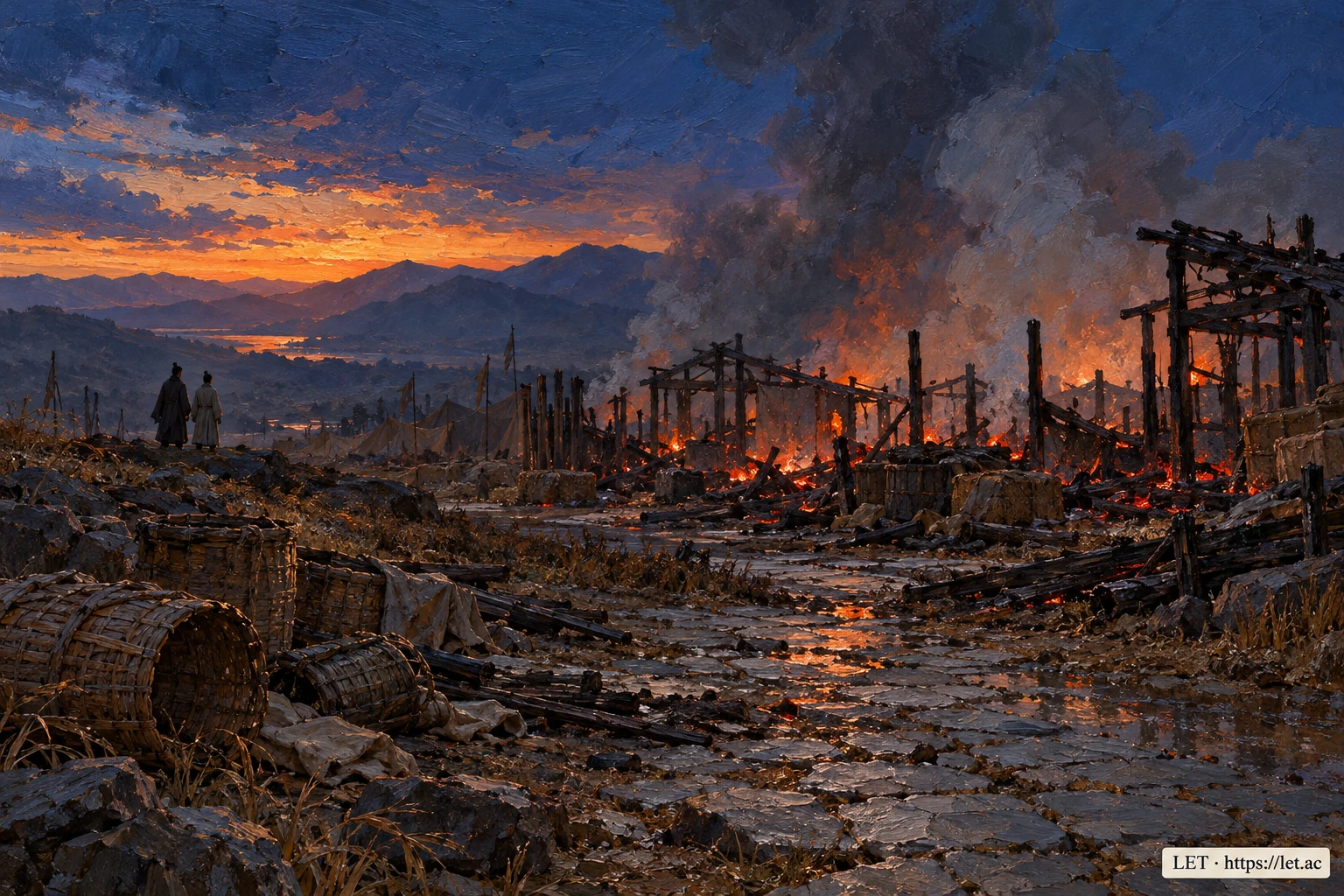
Sun Tzu describes fire as an instrument of war, then turns to the purpose of action, recognition of achievement, and restraint in anger. The chapter closes with what cannot be restored after a state is lost or a person dies. Read the complete twelfth chapter with bilingual interpretations and a fictional community mural decision.
01 / A reading of the text, with context.
1. Read the five forms in their military setting
Sun Tzu says: There are five forms of attack by fire: first, burning the enemy's personnel; second, burning stored supplies; third, burning baggage and transport; fourth, burning storehouses; fifth, burning troop equipment. Using fire requires a means or opportunity, and the materials for making fire must be prepared beforehand.
02 / A reading of the text, with context.
2. Distinguish the text's timing beliefs from a present-day forecast
There is a season for setting fire and a day for beginning it. The season is when the weather is dry. The day is when the Moon is in the lodges Ji, Bi, Yi, or Zhen. These four lunar lodges mark days when the wind rises.
03 / A reading of the text, with context.
3. A changed situation still requires a decision
In any attack by fire, respond to the changes produced by the five forms of fire. If fire breaks out within the enemy's position, respond promptly from outside. If fire breaks out but their troops remain composed, wait and do not attack. Let the fire's force complete its course; if an attack can follow, follow it, and if it cannot, stop. If fire can be set from outside, there is no need to wait for it to begin within; set it at the fitting time.
04 / A reading of the text, with context.
4. Read the stated limits of the military instruments
When fire is set upwind, do not attack from downwind. Daytime winds endure; nighttime winds cease. Every army must understand the changes of the five forms of fire and maintain its guard through calculation. Those who use fire to support an attack are discerning; those who use water to support an attack are strong. Water can cut the enemy off, but cannot deprive them of their stores.
05 / A reading of the text, with context.
5. Account for achievement and the purpose of acting
To win battles and capture objectives but fail to recognize and reward the merit behind them courts disaster. This is called “wasteful lingering.” Thus an enlightened ruler considers the undertaking, and a good commander attends to its achievement and merit. Do not move without benefit; do not employ the army without an attainable gain; do not fight unless faced with danger.
06 / A reading of the text, with context.
6. Leave room for an emotion to pass before an irreversible decision
A ruler must not raise an army out of anger; a commander must not bring about battle out of resentment. Act when the action accords with benefit; stop when it does not. Anger can return to joy, and resentment can return to contentment. But a destroyed state cannot be restored to existence, and the dead cannot be brought back to life. Thus an enlightened ruler is cautious, and a good commander remains on guard. This is the way to keep the state secure and the army whole.
PAUSE & CONSIDER
Ideas to keep
- Name the intended benefit and the consequences before committing to an irreversible action.
- Check actual conditions and agreements instead of relying on a promised date or a familiar rule.
- Keep waiting and stopping available when the next step is not justified.
- Acknowledge the people behind an achievement and arrange what happens to the result afterward.
- Let anger pass, consult those affected, and prefer a reversible trial while the decision is unresolved.
AN ILLUSTRATIVE MODERN SCENARIO
A community mural: an illustrative fictional scenario
A community group is considering a new painting for the wall beside its meeting room. An older mural is already there. Some members find it dated; others remember helping paint it and associate it with the group's beginning. During an argument about the proposal, someone suggests covering it immediately so that the discussion can finally end. The coordinator pauses that suggestion and asks the group to define the actual goal before deciding what should happen to the wall.
The group asks whether it wants clearer information about current activities, room for new artists, a changed appearance, or some combination. It invites earlier contributors and regular users of the room to discuss those aims. Members record the old work in photographs and collect a short account of who made it, with the contributors' agreement. They also recognize that documentation would preserve only part of the work's qualities and would not undo the loss if the original paint were covered.
A few volunteers prepare a small sample on a separate board, leaving the wall available for a later decision. They show it alongside an option for a new removable display. People can comment on the design and whether either option meets the stated purpose. The team explains that approving a sample is not the same decision as covering the mural. It also asks who would take care of a new work and how future changes would be discussed, so enthusiasm about making it includes responsibility afterward.
The proposed completion date arrives before the group has reached an agreement about the old work. Instead of using that date to close the argument by force, members postpone the wall decision. They agree to use the separate display for the next community event and include the earlier contributors' account beside the old mural. The new design can be tried in a limited, removable form, and people have time to see whether it communicates what they wanted.
At the next discussion, several people have changed their view of the new design, and one concern about its wording still needs revision. The earlier anger has eased; the old mural remains available to be considered in the wider plan. The group records the unresolved questions and agrees who will gather further feedback. The fictional outcome is an informed postponement and a useful trial, rather than a final claim that one artistic choice must be right for every participant.
孙子先讨论战争中火攻的对象与条件,再转向行动目的、功劳处理和愤怒时的克制,最后以亡国与死亡的不可恢复作警醒。本篇收录第十二篇完整原文,配有独立英文译写、白话解释、双语解读,以及一个社区决定是否覆盖旧壁画的虚构案例。
01 / 把原文放回语境,慢慢读。
一、在军事语境里读五种火攻
孙子说:火攻有五种:第一是火人,焚烧敌方人员;第二是火积,焚烧储积物资;第三是火辎,焚烧辎重运输;第四是火库,焚烧库藏;第五是火队,焚烧军队器具。实行火攻必须有能够利用的条件或机会,发火所用的器物材料要事先具备。
02 / 把原文放回语境,慢慢读。
二、辨明原文的时日观念
发火有适合的时机,起火也有相应的日期。这里所说的时机,是天气干燥的时候;所说的日期,是月亮运行到箕、壁、翼、轸四宿的时候。原文认为,月亮处于这四宿的日子,风会起来。
03 / 把原文放回语境,慢慢读。
三、情况有变,仍须判断是否继续
凡用火攻,都要依据五种火攻造成的变化作出回应。火在敌方内部发生,应当及早从外面配合;火已经发生,敌军却保持镇定,就应等待而不攻。等火势发挥到尽头,可以随之进攻就进攻,不能随之进攻就停止。若能够从外面发火,不必等待内部先起火,应在相应时机发动;
04 / 把原文放回语境,慢慢读。
四、读清风、火与水在原文中的作用和限制
火从上风处发生,不要从下风处进攻。原文说,白天起的风持续较久,夜间起的风会停止。军队必须了解五种火攻的变化,并依据推算加以戒备。用火辅助进攻,表现出明察;用水辅助进攻,增强力量。水可以隔绝敌军,却不能以此夺去它的蓄积。
05 / 把原文放回语境,慢慢读。
五、处理功劳,也核查行动所为何事
打赢战斗、攻取目标,却不处理和奖赏其中的功劳,会招致祸患,这叫“费留”,即徒耗而滞留。所以,明智的君主应考虑行动,良将应处理功绩。没有利益就不行动,没有可取得的成果就不用兵,不到危急就不交战。
06 / 把原文放回语境,慢慢读。
六、不可恢复的决定之前,给情绪过去的时间
君主不能因愤怒而兴兵,将领不能因怨愤而促成战斗。符合利益就行动,不符合就停止。愤怒可以重新变为喜悦,怨愤可以重新变为愉快;已经灭亡的国家不能重新恢复,已经死去的人不能重新复生。因此,明主慎重,良将警戒,这是使国家安定、军队保全的道理。
停下来,想一想
记住这些要点
- 作出不可恢复的行动前,说清预期益处与后果。
- 核查实际条件与同意,而不只依靠预定日期或熟悉规则。
- 后续步骤缺少依据时,保留等待和停止的选择。
- 承认成果背后出力的人,也安排成果之后怎样延续。
- 让愤怒过去,征询相关的人;决定未明时,先选择可以撤回的试样。
现代情境示例 · 虚构案例
社区旧壁画的去留:虚构的说明案例
一个社区小组考虑给活动室旁的墙画一幅新画,墙上已经有一幅旧壁画。有些成员觉得它过时,有些人记得自己参与绘画,觉得它代表了小组的开始。争论新方案时,有人提议马上把旧画盖掉,好让讨论结束。协调人先停下这个提议,请大家在决定墙面怎样处理之前,说清真正的目标。
大家询问,目标究竟是更清楚地介绍现在的活动、给新作者空间、改变外观,还是兼有几项。小组邀请旧作参与者与活动室的常用者讨论这些目的,经参与者同意,拍照记录旧画,也整理谁曾参与的一段说明。大家同时承认,记录只能保存作品的一部分品质;如果覆盖原颜料,照片并不能把那份损失撤回。
几位志愿者在另备的板上做了小试样,把墙面留待之后决定。他们同时展示另设可移除新展板的选项,让大家讨论设计,以及两种办法是否符合已说清的目的。团队说明,同意试样与同意覆盖旧壁画,是两个不同决定。大家还询问新作由谁照顾,今后变化怎样讨论,让创作的热情也包含之后的责任。
预定完成日期到了,大家对旧作仍未达成一致。成员没有用日期强行结束争论,而是把墙面决定延期。他们商定,下次社区活动先使用另设展板,在旧壁画旁附上早先参与者的说明。新设计以范围有限、可以移除的方式试用,大家也有时间观察,它是否传达了原本想表达的内容。
下一次讨论时,几个人对新设计的看法已经改变,还有一处文字顾虑需要修改。此前的怒气缓和了,旧壁画仍可以放进更完整的方案里考虑。小组记录未解决的问题,商定由谁继续征集反馈。虚构结果是一场有依据的延期和可用的试样,并没有宣布某一种艺术选择必然对每位参与者都正确。
Original Chinese & source
FULL ORIGINAL · TRADITIONAL CHINESE
火攻第十二
孫子曰:凡火攻有五:一曰火人,二曰火積,三曰火輜,四曰火庫,五曰火隊。行火必有因,烟火必素具。
發火有時,起火有日。時者,天之燥也。日者,月在箕、壁、翼、軫也。凡此四宿者,風起之日也。
凡火攻,必因五火之變而應之:火發於內,則早應之於外;火發而其兵靜者,待而勿攻,極其火力,可從而從之,不可從則止;火可發於外,無待於內,以時發之;
火發上風,無攻下風;晝風久,夜風止。凡軍必知有五火之變,以數守之。故以火佐攻者明,以水佐攻者強。水可以絕,不可以奪。
夫戰勝攻取,而不修其功者凶,命曰「費留」。故曰:明主慮之,良將修之,非利不動,非得不用,非危不戰。
主不可以怒而興師,將不可以慍而致戰。合於利而動,不合於利而止。怒可以復喜,慍可以復悅,亡國不可以復存,死者不可以復生。故明主慎之,良將警之,此安國全軍之道也。
The complete Chinese text follows Wikisource’s online transcription of 火攻第十二, revision 7906064, checked on October 12, 2026. LET divides each of the three source paragraphs into two, making six reading sections. Original characters and punctuation are preserved, including 烟火. Traditional annotations informed difficult terms; the ancient wind and lunar-lodge claims are presented as textual beliefs. This is a reading edition, not a comparison of manuscript variants.
English rendering, modern Chinese paraphrase, and commentary were written independently by LET with AI assistance from the Chinese text. They are editorial interpretations, separate from the quoted original. The mural scenario is fictional and is not attributed to Sun Tzu. Its limited artistic analogy is distinct from warfare, death, and the source’s claims about fire, wind, and the Moon. The page interprets an ancient text rather than providing contemporary fire operations or weather predictions.