THE ART OF WAR CHAPTER 13
The Use of Spies
用间篇
Before acting, ask how you know—and whose knowledge you depend on.
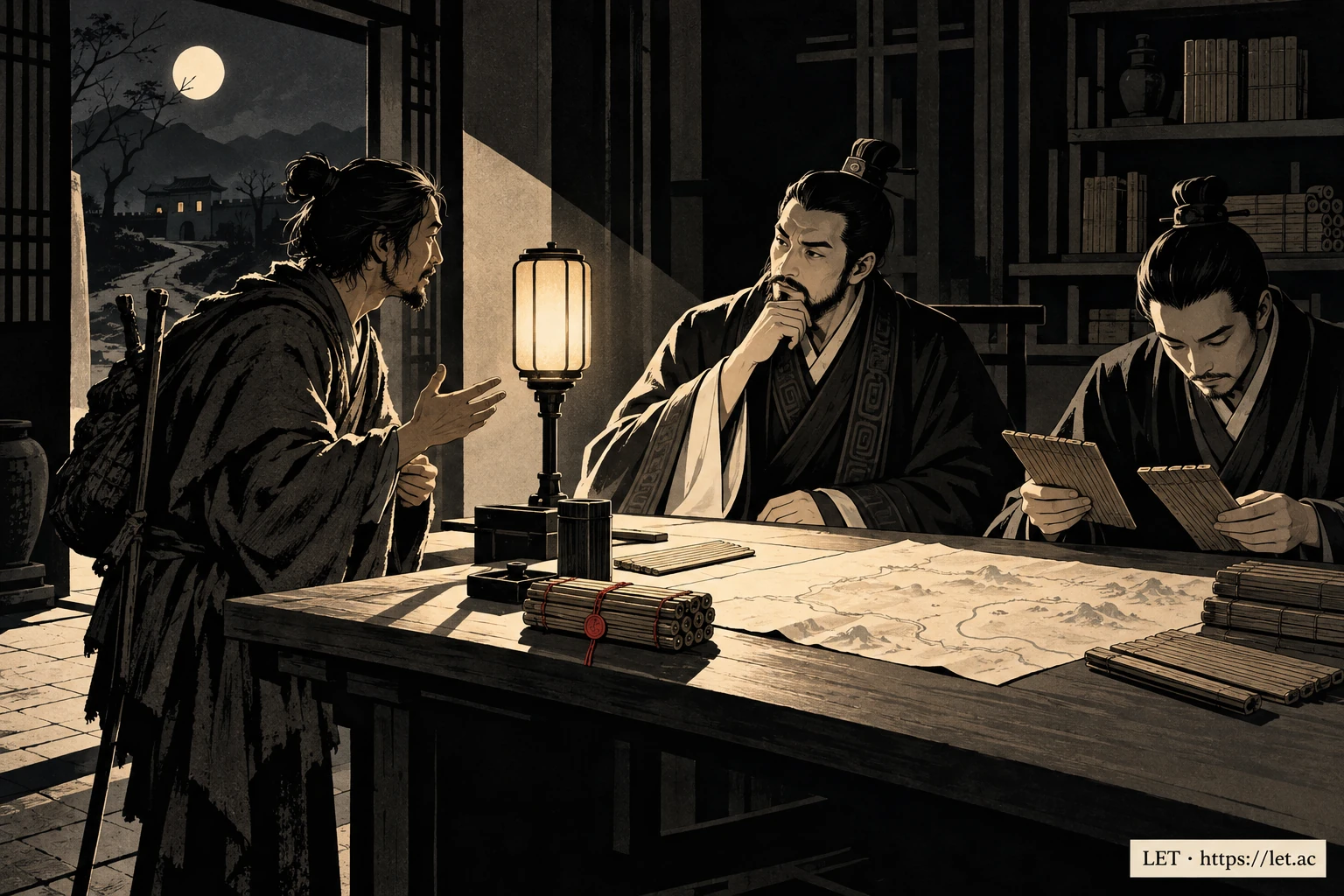
Sun Tzu ends with the cost of ignorance and the human sources of knowledge. The chapter defines five kinds of agents, links trust with reward and secrecy, and retains a harsh system of deception and death. Read the complete text with independent English, modern Chinese, bilingual commentary, and a fictional oral-history team that verifies information through consent and open records.
01 / A reading of the text, with context.
1. Ignorance can carry a public cost
Sun Tzu says: Raising an army of a hundred thousand and sending it a thousand li from home brings costs to the people and demands on the state, with a thousand units of money spent each day. Affairs at home and abroad are disturbed, people grow weary on the roads, and seven hundred thousand households cannot attend to their ordinary work. To face the enemy for years, seeking victory on a single day, yet begrudge ranks, stipends, and a hundred units of money and so remain ignorant of the enemy's situation is the height of inhumanity. Such a person is no commander of people, no helper to the ruler, and no director of victory.
02 / A reading of the text, with context.
2. Knowledge of people must come from people
Thus enlightened rulers and able commanders overcome others when they act and achieve results beyond the ordinary because they know beforehand. This knowledge cannot be obtained from ghosts and spirits, inferred by comparing similar events, or established through measurements and calculations. It must come from people who know the enemy's actual situation.
03 / A reading of the text, with context.
3. Understand the five military categories
There are therefore five kinds of agents: local agents, inside agents, counter-agents, doomed agents, and returning agents. When all five work together and no one can discern their method, this is called a wondrously ordered network, a ruler's treasure. Local agents are people of the enemy's country put to use. Inside agents are its officials put to use. Counter-agents are enemy agents turned to our use. Doomed agents involve creating deceptive events outside, letting our agents learn of them and pass them to enemy agents. Returning agents come back with a report.
04 / A reading of the text, with context.
4. Trust and reward stand beside severe secrecy
Thus among the army's affairs, none require a closer relationship than agents, none greater rewards, and none greater secrecy. Without penetrating wisdom one cannot use agents; without humane and just treatment one cannot direct them; without subtle discernment one cannot obtain the truth from them. Subtle indeed, subtle indeed: there is no matter in which agents cannot be used. If an agent's operation is heard of before it is put into action, the agent and the person to whom it was disclosed are both put to death.
05 / A reading of the text, with context.
5. The original asks for knowledge of specific targets
For an army one intends to strike, a city one intends to attack, or a person one intends to kill, first know the names of the responsible commanders, close attendants, reception officials, gatekeepers, and members of the household staff. Order our agents to find out these names.
06 / A reading of the text, with context.
6. Understand how the source connects its network
Seek out enemy agents who come to spy on us, offer them benefits, guide them, and give them lodging; then counter-agents can be obtained and used. Through the knowledge gained in this way, local and inside agents can be found and employed. Through it, deceptive events can be prepared for doomed agents to convey to the enemy. Through it, returning agents can be sent and brought back at the appointed time. The ruler must understand the work of all five kinds of agents. The knowledge depends above all on counter-agents, so counter-agents must receive generous treatment.
07 / A reading of the text, with context.
7. Read the closing examples as the text's argument
In earlier times, when Yin rose, Yi Zhi had been in Xia; when Zhou rose, Lü Ya had been in Yin. Thus enlightened rulers and able commanders who can employ people of the highest intelligence as agents will achieve great results. This is essential to warfare, what the whole army relies on before it moves.
PAUSE & CONSIDER
Ideas to keep
- Include the work of finding out before committing people to an action or public account.
- Ask what each person witnessed, heard later, or inferred, and preserve those distinctions.
- Check how a claim traveled; repeated versions of one source are not independent confirmation.
- Build cooperative trust through clear purpose, consent, and agreed attribution and sharing.
- State what remains uncertain rather than forcing the evidence into a finished story.
AN ILLUSTRATIVE MODERN SCENARIO
An oral-history exhibition: an illustrative fictional scenario
A neighborhood group prepares an exhibition about the relocation of a covered market in the 1980s. Its first draft gives a single move date and a confident explanation for the delay, based on a story repeated at several meetings. Before printing the panels, the team asks how it knows. Volunteers separate direct recollections, later hearsay, photographs, and documents into a source list. Several retellings turn out to trace back to the same conversation, so they count as one line of information rather than separate confirmation.
Residents choose whether to take part in interviews. The team explains the exhibition's purpose and asks separately about recording, keeping a transcript, attribution, and sharing a quotation. Participants can mark a passage for the working notes without agreeing to put it on a public panel. Interviewers ask what people personally saw and how certain they are about a date. They preserve phrases such as I think and I heard later instead of editing uncertainty out of the account. Contributors review the passages proposed for display.
One resident remembers temporary tables at the new site in the middle of the decade. Another associates the move with an opening notice from 1988. With the owners' agreement, the team examines photographs and reads the public opening notice. The notice establishes the date of a formal opening; it does not establish when every stall first traded. The photographs suggest an earlier stage but do not settle its precise date. The team keeps the two claims distinct instead of selecting the most vivid memory as the whole answer.
A rumor says the delay resulted from missing funds, but the materials consulted provide no confirmation. The team does not turn the rumor into a factual caption. Its notes record the claim as unverified and explain that the reason for the delay remains unresolved in the available material. Participants agree which recollections may be quoted, and the panels label them as recollections alongside the separately cited public record. Readers can see where the account has support and where a question remains.
In this fictional exhibition, the final panels show a sequence of remembered and documented stages rather than one falsely exact move date. The team keeps a source list and a record of the agreed sharing permissions so that a future revision can be checked. When a contributor corrects a detail during review, the relevant passage and its source note are updated together. The useful outcome is a more transparent account and a cooperative relationship in which people remain participants, not agents to be deceived or used covertly.
孙子以无知的代价与知情的来源收束全书,说明五种间者、信任赏赐与隐密,也保留欺敌和致死制度的严厉原义。本篇配完整原文、独立英文译写、白话与双语解读,并以自愿采访、公开材料核实的虚构口述史案例作有限类比。
01 / 把原文放回语境,慢慢读。
一、无知也有由众人承担的代价
孙子说:兴师十万、出征千里,百姓的开支和国家的供给每天耗费千金,内外受到扰动,运送者疲于道路,七十万户不能从事原有生计。与敌方相持多年,争取一日取胜,却吝惜爵位、俸禄和百金,不肯取得敌情,是极不仁的做法;这样的人不配统领众人,不配辅佐君主,也不能主持胜利。
02 / 把原文放回语境,慢慢读。
二、人的实情,须从知情的人取得
明君贤将行动能够胜过对方、取得出众成果,是因为事先知情。这种先知,不能向鬼神求取,不能只用类似事件比附,也不能仅靠尺度计算验证;必须从了解敌方实情的人那里取得。
03 / 把原文放回语境,慢慢读。
三、完整理解五间的军事分类
用间有五种:乡间、内间、反间、死间、生间。五种同时配合,对方不能看清它们的运作,称为“神纪”,是君主重视的工具。乡间,利用敌方当地人;内间,利用敌方官员;反间,把敌方间者转为己方所用;死间,在外制造虚假事迹,让己方间者得知,再传给敌方间者;生间,往后能够回来报告。
04 / 把原文放回语境,慢慢读。
四、信任与赏赐,也与严厉保密并存
军中之事,没有比间者更需要亲近信任的,没有比间者更需厚赏的,也没有比间事更需隐密的。没有通达的智慧不能用间,没有仁义待遇不能使间,没有精细判断不能取得真实情报。微妙啊,微妙啊,事情无不可以用间。间事未实行就先泄露被人得知,间者与被告知的人都要处死。
05 / 把原文放回语境,慢慢读。
五、原文所知,是具体的军事对象
凡是想攻击的军队、想攻取的城池、想杀的对象,都必须先了解守将、亲近人员、掌通报接待者、守门者与舍人的姓名,命间者查明。
06 / 把原文放回语境,慢慢读。
六、理解原文怎样连接五间
必须找出前来刺探己方的敌间,给以利益,引导并安置,就能取得反间加以运用。由此得知情况,便能找到乡间、内间使用;由此知情,可以制造虚假事迹,让死间传给敌方;由此知情,可以让生间按期往返。五间之事,主事者必须了解;取得这些知识尤其依靠反间,所以对反间不能不厚待。
07 / 把原文放回语境,慢慢读。
七、把结尾典故放回原文论证
从前殷兴起时,伊挚曾在夏;周兴起时,吕牙曾在殷。因此,明君贤将能够用极有智慧的人为间,就能建立大功。这是用兵的要事,是全军赖以行动的知识基础。
停下来,想一想
记住这些要点
- 让人投入行动或公开叙述之前,把查明情况的工作算进去。
- 问清亲历、后闻与推断,并保留它们的区别。
- 查看信息怎样传来,同一来源的反复转述不等于独立核实。
- 通过清楚目的、同意与约定署名共享范围,建立合作信任。
- 说明尚未确定的地方,不把材料强行拼成定论。
现代情境示例 · 虚构案例
地方口述史展览:虚构的说明案例
一个社区小组筹办旧市场迁址的口述史展,故事发生在二十世纪八十年代。初稿根据几次聚会反复出现的说法,写了唯一迁址日期,也肯定地解释为何延迟。印展板前,团队先问凭什么知道。志愿者把亲历回忆、后来听闻、照片与文献分开列入来源表。查下去,几份转述原来出自同一场谈话,因此只算一条信息来源,不算彼此独立的证明。
居民自主选择是否接受采访。团队说明展览目的,分别商定是否录音、保存文字、怎样署名,以及哪段话可以共享。有些内容可留作工作笔记,却不等于已获同意放上公开展板。采访者问本人实际看见什么,对日期有多确定;保留“我想”“后来听说”等表达,不把不确定性编辑掉。拟展示的片段也请贡献者复看。
一位居民记得八十年代中期,新地点已有临时摊桌;另一位把迁址与一九八八年的开幕公告联系起来。征得所有者同意,团队查看照片,也查阅公开开幕公告。公告能说明正式开幕日期,不能说明每一摊首次营业的时间;照片提示可能较早的阶段,也没有解决确切日期。团队让两项主张各自保留,不把最鲜明的回忆选作全部答案。
另有传闻说,延期是因为款项去向不明,但查阅的材料没有证实。团队不把传闻写成事实说明,工作记录标注“未核实”,也说明现有材料尚不能确定延期原因。参与者同意哪些回忆可引用,展板把它们标作回忆,与另行注明来源的公开记录并列。读者能看见哪里有依据,哪里仍留问题。
这个虚构展览最后呈现的是回忆与记录所支持的若干阶段,没有制造一个虚假的精确迁址日。团队保留来源表及约定的共享范围,便于以后修订时核查。贡献者在复看中更正细节,相关片段与来源说明也一起更新。所得是一份较透明的叙述,以及让人始终作为参与者合作的关系,而非把人变成需要欺骗或暗中使用的间者。
Original Chinese & source
FULL ORIGINAL · TRADITIONAL CHINESE
用間第十三
孫子曰:凡興師十萬,出征千里,百姓之費,公家之奉,日費千金,內外騷動,怠于道路,不得操事者,七十萬家。相守數年,以爭一日之勝,而愛爵祿百金,不知敵之情者,不仁之至也,非人之將也,非主之佐也,非勝之主也。
故明君賢將,所以動而勝人,成功出於眾者,先知也。先知者,不可取於鬼神,不可象於事,不可驗於度,必取於人,知敵之情者也。
故用間有五:有鄉間,有內間,有反間,有死間,有生間。五間俱起,莫知其道,是謂「神紀」,人君之寶也。鄉間者,因其鄉人而用之;內間者,因其官人而用之;反間者,因其敵間而用之;死間者,為誑事於外,令吾間知之,而傳於敵間也;生間者,反報也。
故三軍之事,莫親於間,賞莫厚於間,事莫密於間,非聖智不能用間,非仁義不能使間,非微妙不能得間之實。微哉!微哉!無所不用間也。間事未發而先聞者,間與所告者皆死。
凡軍之所欲擊,城之所欲攻,人之所欲殺,必先知其守將、左右、謁者、門者、舍人之姓名,令吾間必索知之。
必索敵人之間來間我者,因而利之,導而舍之,故反間可得而用也;因是而知之,故鄉間、內間可得而使也;因是而知之,故死間為誑事,可使告敵;因是而知之,故生間可使如期。五間之事,主必知之,知之必在於反間,故反間不可不厚也。
昔殷之興也,伊摯在夏;周之興也,呂牙在殷。故明君賢將,能以上智為間者,必成大功。此兵之要,三軍之所恃而動也。
The complete traditional Chinese text follows Wikisource’s online transcription of 用間第十三, revision 7906064, checked on October 12, 2026. Seven reading sections are LET’s editorial divisions of five source paragraphs. Traditional commentaries informed interpretation; the Yi Zhi and Lü Ya examples are the text’s claims, and this reading edition does not establish their secret activities or compare manuscript variants.
English rendering, modern Chinese paraphrase, and commentary were written independently by LET with AI assistance from the Chinese text. They are editorial interpretations, separate from the quoted original. The oral-history exhibition is fictional and is not attributed to Sun Tzu. Its consensual information checking is LET’s cooperative analogy, distinct from the original system of secrecy, deception, coercion, and death.